
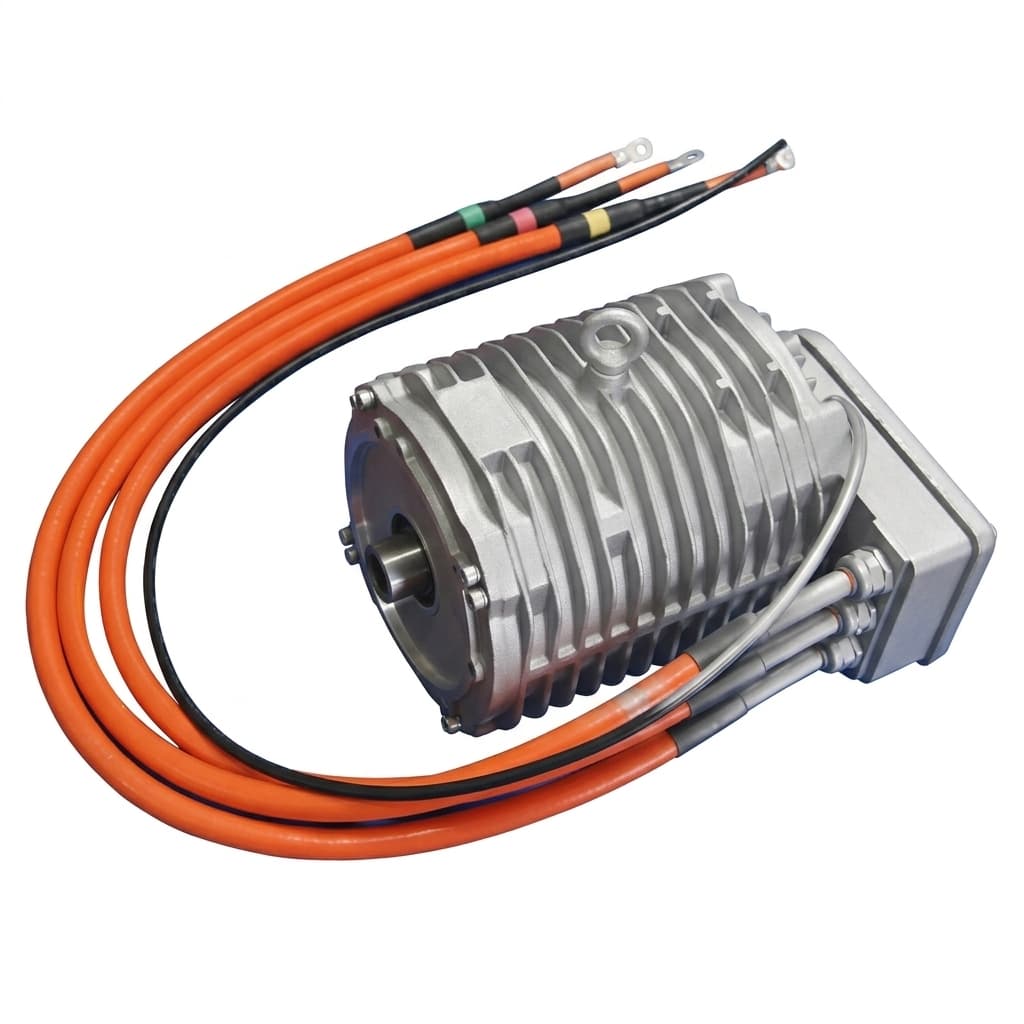
The Industry Shift to Rare-Earth-Free Traction Drives: Lessons from Global EV Leaders
Global automakers are moving away from rare-earth permanent magnets. Explore the engineering behind the new wave of magnet-free EV traction motors.
[!NOTE] Executive Summary (TL;DR):
- The Shift: Global EV leaders are abandoning Neodymium (NdFeB) magnets due to extreme supply chain volatility.
- The Technology: Wound Rotor Synchronous Motors (WRSM / EESM) replace permanent magnets with an active electromagnetic rotor.
- The Engineering Advantage: By utilizing active field weakening, WRSMs eliminate back-EMF drag at high speeds, significantly improving highway cruising efficiency compared to legacy IPM architectures.
The Industry Shift to Rare-Earth-Free Traction Drives: Lessons from Global EV Leaders
When major electric vehicle pioneers announced their intentions to design next-generation drive units completely free of rare-earth elements, it sent shockwaves through the global supply chain. For years, the Interior Permanent Magnet (IPM) motor was considered the benchmark of EV propulsion, offering unmatched torque density and low-speed efficiency.
However, the strategic pivot away from Neodymium (Nd) and Dysprosium (Dy) by leading automakers signals a long-term engineering direction. We break down the engineering forces driving this change and how magnet-free traction motors are changing how automotive traction motors are sourced.
The Catalyst for Change: Supply Chain Security
The decision to abandon rare earths is rarely driven by a desire for better low-speed performance; it is driven by risk mitigation and scale.
As automakers target production volumes in the tens of millions of units annually, rare-earth supply growth has not kept pace with projected EV demand. On top of that, the extreme price volatility of these commodities makes sub-$25,000 mass-market EVs virtually impossible to cost-engineer accurately.
To achieve true mass adoption, OEMs need a motor architecture built from abundant, globally traded commodities: Copper and Steel.
The Rise of the Wound Rotor Synchronous Motor (WRSM)
To replace the magnetic flux previously provided by rare-earth magnets, automotive engineers are turning to the Wound Rotor Synchronous Motor (WRSM), also known as the Externally Excited Synchronous Motor (EESM).
In a WRSM, the permanent magnets inside the rotor are replaced by a dense bundle of copper windings. The vehicle's inverter injects a precisely controlled DC current into these rotor windings (usually via a brushless exciter or high-durability slip rings) to create an electromagnet.
Notice how the WRSM (Blue) maintains a high, flat power plateau at high RPMs because the rotor field can be actively weakened, unlike IPMs which suffer from uncontrollable back-EMF drag.
Advantages for Highway Cruising
While WRSMs require a slightly larger footprint to match the peak launch torque of an IPM motor, they possess a notable advantage for EVs: Active Field Weakening.
In a permanent magnet motor, the magnets are always "on." At high highway speeds, the motor spins so fast that the magnets generate a high Back-Electromotive Force (Back-EMF). To prevent this voltage from destroying the inverter, the system must inject a continuous, energy-wasting "weakening current" into the stator just to fight the magnets. This significantly reduces highway efficiency.
With a WRSM, the motor controller can simply turn down the power to the rotor electromagnet. By actively reducing the magnetic field at high speeds, Back-EMF is mitigated, and highway cruising efficiency skyrockets. This directly translates to longer real-world range for highway driving.
The Manufacturing Challenge: Automated Hairpin Winding
The primary hurdle in adopting WRSM technology is manufacturing complexity. Winding dense copper coils into a spinning rotor requires extreme precision and balance.
To solve this, Tier-1 suppliers and specialized manufacturers (like Magnet-Free Motor) have developed heavily automated Hairpin Winding assembly lines. By using rigid, rectangular copper bars instead of thin round wires, manufacturers can achieve high slot-fill factors (packing more copper into less space). These hairpins are inserted robotically and laser-welded at high speeds, resulting in a highly robust, mass-producible rotor capable of withstanding extreme centrifugal forces at 20,000+ RPM.
Technical Comparison: IPM vs. WRSM vs. SRM for EV Traction
To understand why the automotive industry is shifting, engineers must compare the three dominant architectures across critical vehicle-level metrics.
| Metric | IPM (Interior Permanent Magnet) | WRSM / EESM (Wound Rotor) | SRM (Switched Reluctance) |
|---|---|---|---|
| Low-Speed Torque Density | Excellent | Very Good | Good |
| High-Speed (Highway) Efficiency | Poor (High Back-EMF losses) | Excellent (Active field weakening) | Very Good |
| Rare-Earth Dependency | 100% (Nd, Dy, Tb) | 0% (Magnet-Free) | 0% (Magnet-Free) |
| Rotor Durability (High RPM) | Good (Requires carbon sleeving) | Good | Excellent (Solid steel block) |
| Inverter Complexity | Standard Field Oriented Control (FOC) | FOC + Exciter Control Circuit | High (Complex acoustic mitigation) |
| NVH (Noise & Vibration) | Very Quiet | Very Quiet | Moderate (Requires advanced DTC) |
The Engineering Breakthrough: Active Field Control
The primary advantage of WRSM for electric vehicles is its dynamic adaptability.
- City Driving (High Torque Needed): The inverter commands maximum DC current to the rotor's brushless exciter. The rotor becomes a strong electromagnet, providing the instant launch torque required for 0-60 mph acceleration.
- Highway Cruising (Low Torque, High Speed): The inverter significantly reduces the rotor excitation current. The magnetic flux drops, effectively neutralizing the Back-EMF that plagues IPM motors. The motor coasts with almost zero magnetic drag, yielding a significant improvement in MPGe and extending real-world highway range.
Hairpin Winding: The Key to Mass Production
WRSMs historically struggled with power density because traditional round-wire winding couldn't pack enough copper into the rotor and stator.
The industry's solution is Automated Hairpin Winding. By utilizing heavy-gauge, rectangular copper bars:
- Slot Fill Factor jumps from ~45% to over 70%.
- Thermal Resistance drops significantly, as flat bars conduct heat directly to the cooling jacket.
- Continuous Power increases, allowing EVs to sustain high speeds without thermal derating.
For Tier-1 suppliers, mastering robotic hairpin forming and laser welding is the barrier to entry for the next generation of rare-earth-free traction drives.
Looking Ahead
The pivot to rare-earth-free traction motors is the final step in decoupling the EV revolution from fragile supply chains. As advanced inverter topologies (like Silicon Carbide - SiC) and automated hairpin winding processes mature, the WRSM architecture will rapidly become the dominant force in the global EV market—delivering high performance, long highway range, and rock-solid supply chain economics.
Related Reading
- EESM vs. IPM Motors: Procurement Comparison — Cost and engineering trade-offs for WRSM/EESM adoption.
- Hairpin Winding in EV Traction Motors — The manufacturing technology enabling high-volume EESM production.
- Rare Earth Price Forecast 2026 — The commodity data behind the automotive industry's magnet-free shift.
Author

Categories
More Posts
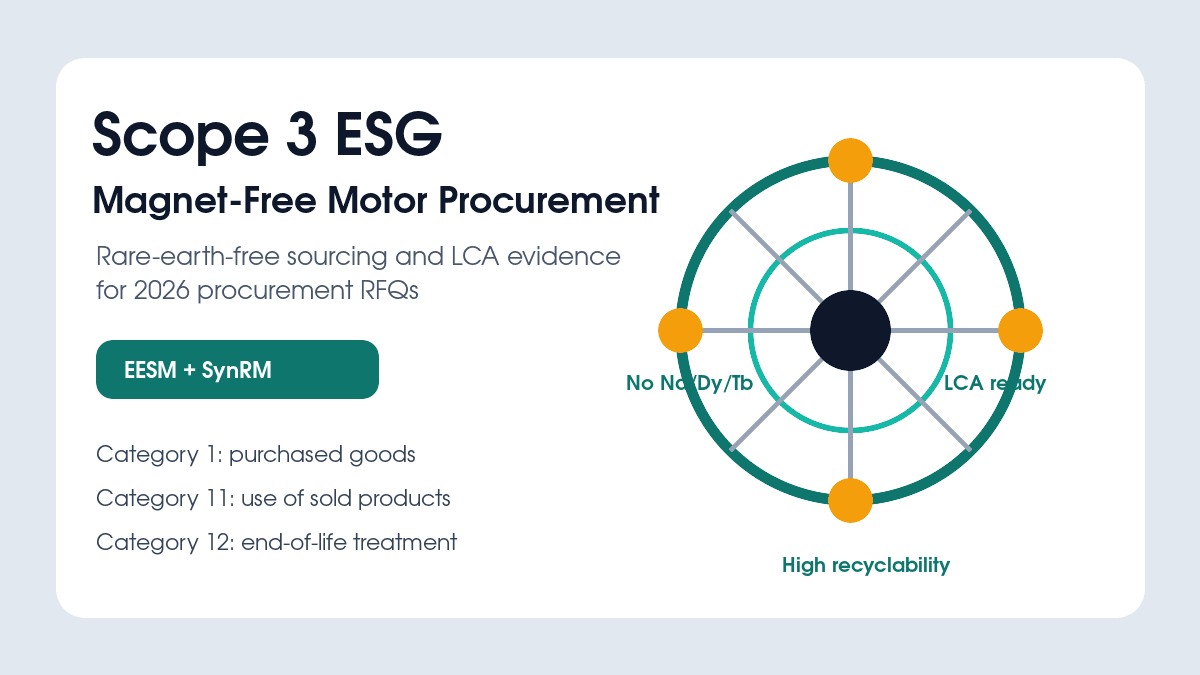
Scope 3 Emissions & ESG: The Magnet-Free Motor Procurement Strategy for 2026
Use magnet-free motor sourcing to lower Scope 3 emissions, reduce rare-earth ESG risk, and request LCA evidence in 2026 procurement RFQs.
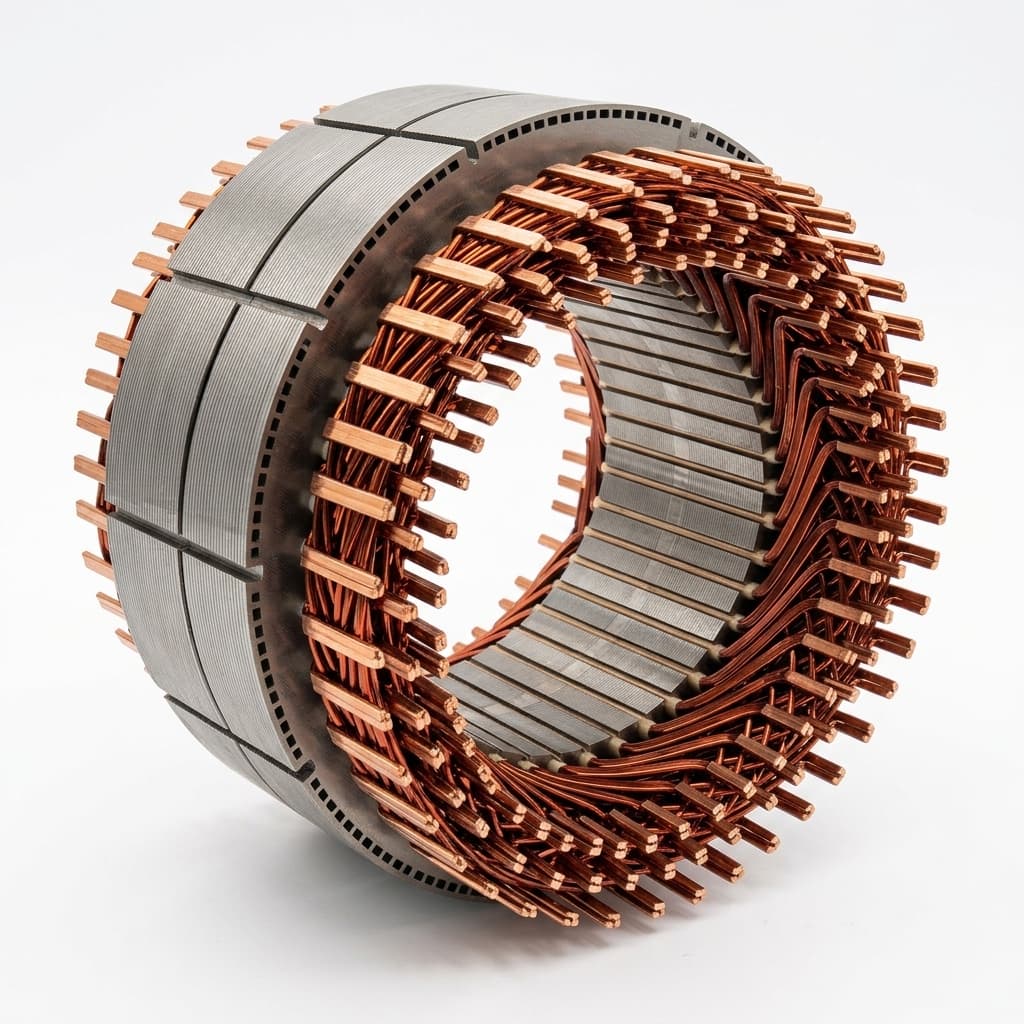
The Role of Hairpin Winding in High-Performance EV Traction Motors
Learn why automated hairpin winding technology is essential for maximizing power density and thermal efficiency in next-generation EV traction motors.
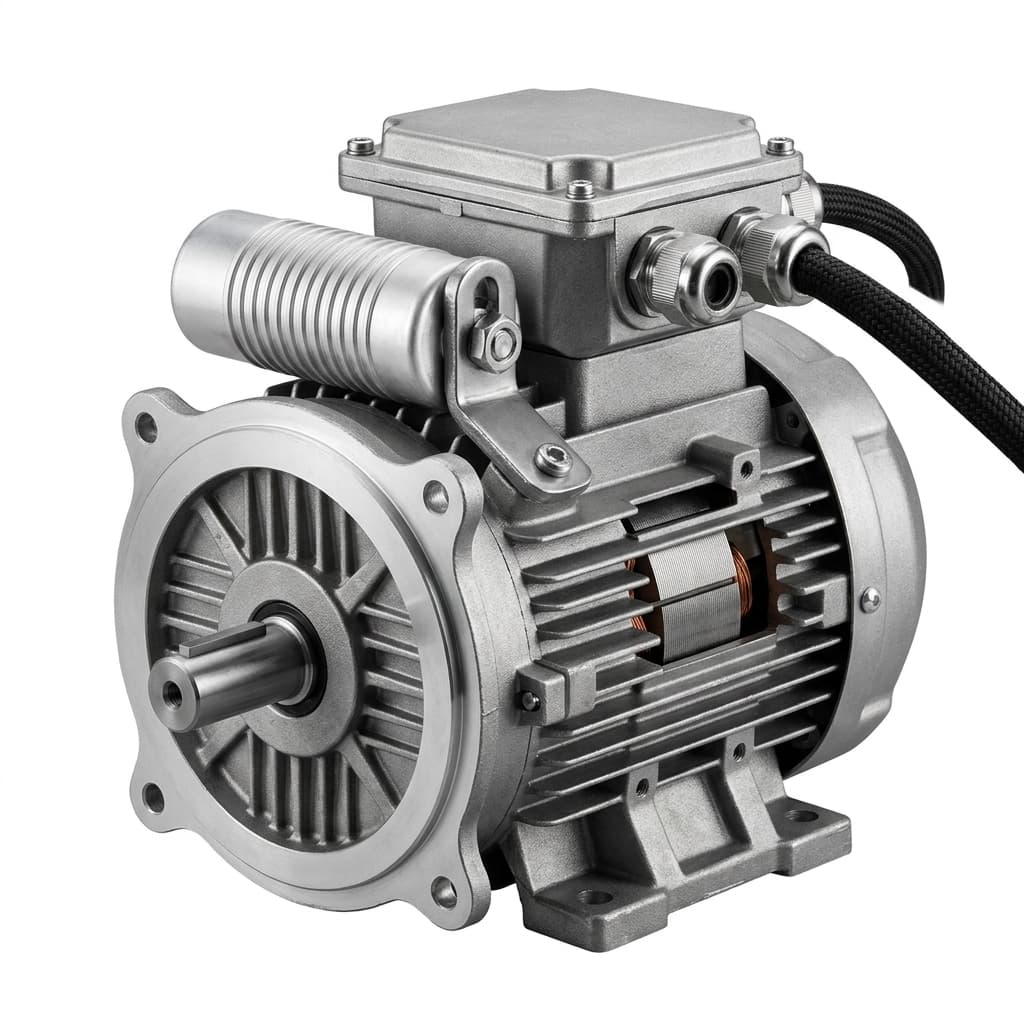
Understanding Switched Reluctance Motors (SRM) for Harsh Environments
Explore the robust architecture of Switched Reluctance Motors (SRM) and why they excel in extreme temperatures, high vibration, and harsh industrial settings.