
EESM vs. IPM Motors in 2026: Cost, Supply Chain, and Procurement Guide
Compare EESM vs. IPM motors for magnet-free motor sourcing in 2026: rare-earth risk, copper cost, inverter needs, efficiency, and RFQ checks.
EESM vs. IPM Motors in 2026: Procurement & Engineering Comparison
As EV production and industrial electrification scale in 2026, procurement teams need to make a concrete decision: continue specifying Interior Permanent Magnet (IPM) motors with rare-earth exposure, or evaluate Externally Excited Synchronous Motors (EESM) that eliminate that exposure entirely. This guide lays out the engineering trade-offs, cost structures, and supplier qualification criteria for both architectures.
EESM replaces rare-earth magnets with a copper-wound rotor and an independent excitation circuit. The transition is not a drop-in swap — it changes rotor manufacturing, inverter requirements, thermal management, and sourcing economics. Whether it makes sense depends on your volume, duty cycle, and supply chain risk tolerance.
This guide is designed for buyers, procurement managers, distributors, importers, and technical engineers comparing EESM vs. IPM motors for global sourcing programs in 2026. It breaks down the mechanical physics, supply chain economics, cost model sensitivities, high-speed performance trade-offs, and critical supplier evaluation criteria necessary to make a confident sourcing decision.
Scope and limitations: this is a procurement and application-engineering guide for traction motors, industrial drives, commercial vehicle e-axles, and high-speed rotating equipment. It is not a substitute for a motor dyno test, inverter validation plan, thermal model, or homologation review. Treat the cost ranges below as screening assumptions for RFQ planning, then validate them against your supplier quotes, production volume, duty cycle, and regional commodity exposure.
1. The Core Engineering Difference: Rotor Physics
To understand the procurement implications, we must first understand the physics driving the cost and performance of these two motor topologies. In any synchronous AC motor, torque is generated by the interaction between a rotating magnetic field in the stator and a secondary magnetic field in the rotor. The critical difference lies entirely in how that rotor field is created.
IPM (Interior Permanent Magnet) Architecture
In an IPM motor, the rotor’s magnetic field is provided by permanent magnets embedded deep within the steel laminations of the rotor core. These magnets are typically composed of Neodymium-Iron-Boron (NdFeB), often heavily doped with heavy rare-earth elements (HREEs) like Dysprosium (Dy) or Terbium (Tb) to prevent demagnetization at high operating temperatures.
- Advantage: Because the magnets generate a constant flux field without requiring external power, there are zero "copper losses" (I²R losses) in the rotor. This results in exceptional efficiency at low speeds and high torque density.
- Disadvantage: The magnetic flux is permanent and fixed. At high speeds, the motor generates a high Back-Electromotive Force (Back-EMF). To prevent this Back-EMF from exceeding the battery or inverter voltage, the inverter must inject a "field-weakening" current into the stator to counteract the magnets. This field-weakening current consumes significant energy, significantly reducing the motor's overall efficiency during high-speed cruising.
EESM (Externally Excited Synchronous Motor) Architecture
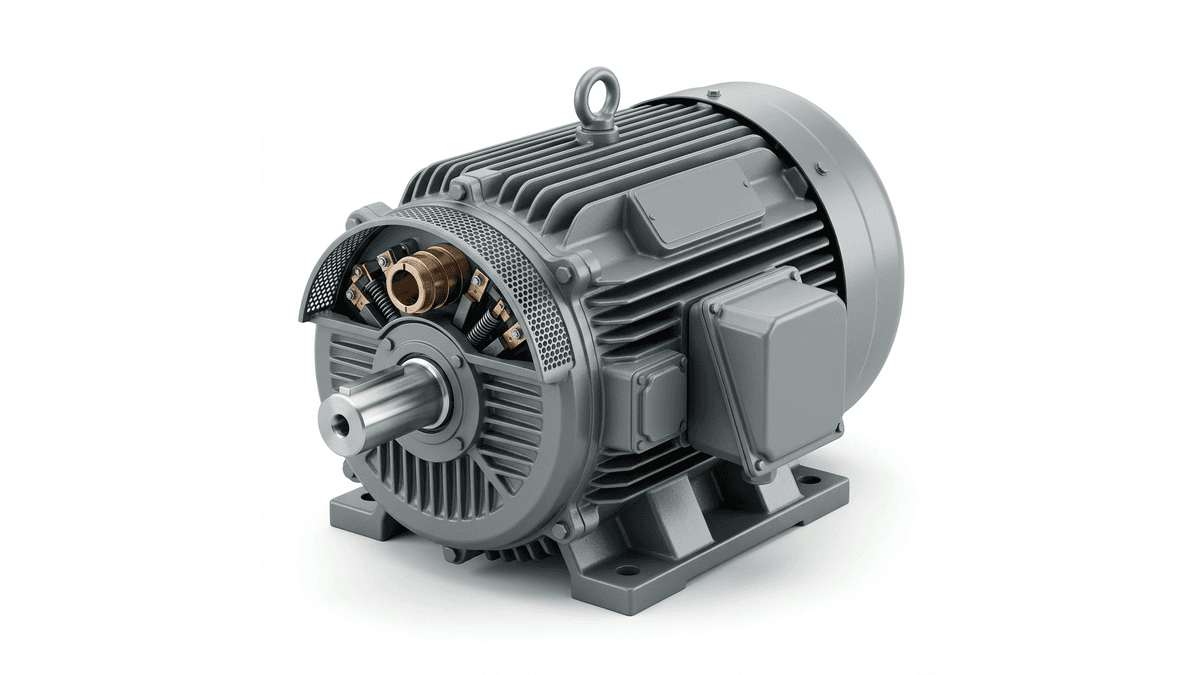
An EESM replaces permanent magnets with an electromagnet within the rotor. The rotor is wound with insulated copper wire. To generate the magnetic field, a separate DC excitation current is continuously supplied to these rotor windings.
- Advantage: The magnetic field is controllable. At low speeds, maximum current can be supplied for high torque. At high speeds, the excitation current can be actively reduced, lowering the magnetic flux and reducing dependence on stator field-weakening. That can improve high-speed continuous operation when the inverter, excitation hardware, and thermal design are matched to the duty cycle.
- Disadvantage: Because the rotor relies on electrical current passing through copper wire, it generates resistive heat (rotor copper losses). This slightly reduces peak efficiency at low speeds and complicates rotor thermal management. On top of that, transferring power to a spinning rotor requires specialized excitation hardware.
System Architecture Visualized
2. Supply Chain & Cost Economics
For procurement teams, the motor transition is less about physics and entirely about risk mitigation and cost stabilization. In 2026, the fragility of the rare-earth supply chain has reached critical levels, prompting major Tier-1 suppliers and OEMs to actively diversify.
Rare-Earth Dependency vs. Copper Pricing
IPM motors require Neodymium (Nd) and, in high-temperature designs, may require Dysprosium (Dy) or Terbium (Tb). Public IEA and USGS data show that rare-earth mining, separation, and permanent-magnet production remain highly concentrated compared with copper and electrical steel. This concentration creates procurement vulnerability: if export controls, quotas, or trade disputes affect magnet materials, buyers can see quote validity shrink, safety-stock requirements rise, and supplier allocation become more important than spot price. On top of that, Dysprosium and Terbium are expensive heavy rare earths, adding ESG and traceability questions for brands pursuing lower-risk material sourcing.
EESM relies on two standard commodities: electrical steel and copper. Copper prices fluctuate on the LME and have trended upward with electrification demand, but the supply chain is geographically diverse (South America, North America, Australia, Africa) and heavily traded. A single-region disruption is unlikely to halt global copper supply, which gives procurement teams a more predictable basis for long-term agreements and forward contracts.
Cost Breakdown & Volume Scaling
At low volumes, IPM has a simpler BOM: a standard stator, a laminated steel rotor with inserted permanent magnets, and straightforward assembly. The manufacturing process is well-understood, though the raw material cost depends heavily on NdFeB spot pricing.
EESM, however, introduces significant manufacturing complexity. The rotor must be wound with copper wire—a process historically more complex than stator winding due to the rotational stresses the wire will endure. Additionally, the motor requires an excitation module (either a slip-ring/brush assembly or a wireless inductive power transfer module). At lower production volumes, specialized EESM rotor winding machinery, rotor balancing, containment, and excitation validation can make the unit cost higher than IPM even when the raw material basket is more predictable.
However, the economics can flip at scale. When annual production volumes are high enough for dedicated automation and validated excitation supply, the amortized cost of the advanced winding machinery becomes much less important. At this scale, replacing rare-earth magnets with copper windings can move EESM toward cost parity with IPM, especially for programs where rare-earth price risk, supplier allocation risk, and magnet traceability carry a real procurement premium. This volume-driven cost logic is one reason automotive OEMs and Tier-1 suppliers continue evaluating EESM for global platforms.
3. Decision Matrix: EESM vs. IPM
The following comparison matrix summarizes the key trade-offs based on 2026 supply chain conditions and current production maturity.
| Evaluation Criteria | IPM (Interior Permanent Magnet) | EESM (Externally Excited) |
|---|---|---|
| Material Sourcing Risk | High (Rare-earth mining, processing, and magnet production are concentrated) | Lower (Copper and electrical steel have broader global supply bases) |
| Cost Volatility (2026) | High (Subject to sudden export quotas) | Moderate (Standard LME copper fluctuations) |
| High-Speed Efficiency | Degraded (High field-weakening stator losses) | Excellent (Active flux reduction eliminates drag) |
| Low-Speed Torque & Efficiency | Excellent (Zero rotor copper losses) | Good (Requires constant excitation current) |
| Manufacturing Complexity | Medium (Magnet insertion, retention, balancing) | High (Complex rotor hairpin winding, exciters) |
| Power Density & Weight | Highest (Maximum torque per kg) | Slightly Lower (Requires a slightly larger rotor) |
| Environmental & ESG Impact | Higher scrutiny (Rare-earth mining, refining, and magnet traceability) | Lower rare-earth exposure (Still requires copper/steel sourcing and process controls) |
| Inverter Requirements | Standard 3-Phase Inverter | Requires 3-Phase + Excitation Control (Dual output) |
4. Excitation Technology: The Hidden EESM Variable
If you commit to sourcing EESM, you must understand how the excitation current is transferred to the spinning rotor. This is the single biggest reliability variable in magnet-free motors, and procurement teams must scrutinize the supplier's approach.
1. Slip Rings and Carbon Brushes (Traditional Method)
This is the most mature and cost-effective way to transfer DC power to a spinning rotor. Physical carbon brushes slide against copper slip rings on the rotor shaft.
- Pros: Low initial cost, highly proven, simple control logic.
- Cons: Friction creates wear. Brushes generate conductive carbon dust inside the motor housing, and they eventually wear out, requiring physical maintenance (brush replacement) at roughly 150,000 to 200,000 miles in an EV, or every few years in an industrial setting. For maintenance-free industrial automation, this is often a dealbreaker.
2. Brushless Inductive Exciters (Modern Approach)
Next-generation EESM suppliers utilize a wireless power transfer method, similar to how a wireless phone charger works. A stationary primary coil induces an AC current into a rotating secondary coil mounted on the shaft. A small, rotating diode rectifier circuit then converts this AC to the DC needed for the rotor windings.
- Pros: Zero physical contact, zero friction, zero wear, and zero maintenance. Matches the lifespan and reliability of an IPM motor perfectly.
- Cons: Higher upfront cost, increased mechanical complexity on the shaft, and requires careful high-frequency electromagnetic design to prevent interference.
When auditing an EESM supplier, clarifying their excitation technology is paramount. For consumer vehicles, advanced slip-rings with enclosed dust-catchers are currently popular. For heavy-duty industrial or commercial applications, brushless inductive excitation is heavily preferred.
5. Application Boundaries: When to Choose Which?
Despite the momentum behind EESM, IPM is not obsolete. Each architecture has distinct application boundaries that dictate the best procurement strategy.
When to Source IPM:
- Ultra-Compact Applications: If space constraints are absolute (e.g., in-wheel motors, robotics joints, aerospace actuators), the unmatched power density of rare-earth magnets makes IPM the only viable choice.
- Low-Speed, Continuous High-Torque Environments: In applications like heavy winches, slow-moving conveyors, or urban stop-and-go delivery vehicles, the motor operates mostly at low speeds. Here, EESM's continuous rotor copper losses degrade efficiency, whereas IPM excels.
- Legacy System Integration: If you are swapping a motor but keeping the existing drive/inverter architecture, you must use an IPM or induction motor. EESM requires specialized inverter hardware and software to manage the excitation circuit.
When to Source EESM (Magnet-Free):
- High-Volume Global OEM Platforms: For mass-market vehicles or widespread industrial machinery, EESM can reduce rare-earth exposure and make long-term sourcing more predictable when the supplier has mature rotor winding and excitation automation.
- Prolonged High-Speed Cruising: For long-haul electric trucks, highway-focused passenger EVs, or high-speed industrial spindles, the ability of the EESM to actively weaken the rotor field yields superior overall cycle efficiency compared to IPM.
- Strict ESG Compliance Mandates: Companies facing strict material traceability requirements or those wanting to market a rare-earth-free product can use EESM to reduce permanent-magnet dependency, while still auditing copper, electrical steel, insulation, and manufacturing energy.
6. Supplier Qualification Checklist for Magnet-Free EESM
If your engineering and procurement teams have aligned on moving forward with magnet-free EESM architectures, the next challenge is selecting a qualified manufacturing partner. EESM production requires advanced competencies that many traditional IPM suppliers do not possess.
Use this detailed, multi-point checklist during your Request for Quotation (RFQ) and facility audit phases:
- Advanced Rotor Hairpin Winding Capabilities: Does the supplier utilize automated hairpin or continuous-wave winding for the rotor? High slot-fill factors are critical for minimizing rotor resistance and heat. Traditional pull-in winding is insufficient for high-performance EESM.
- Excitation System Maturity: Which excitation method do they use? If slip rings, what is the validated wear life of the carbon brushes, and how is the conductive dust isolated from the stator windings? If brushless inductive, ask for EMI (Electromagnetic Interference) test reports and efficiency curves of the power transfer.
- Rotor Thermal Management & Cooling: The rotor in an EESM generates significantly more heat than an IPM rotor. Does the supplier implement advanced internal shaft cooling, direct oil spray on the rotor end-turns, or passive thermal dissipation pathways?
- High-Speed Rotor Balancing & Centrifugal Containment: Copper windings are heavy and prone to outward deformation under high centrifugal forces. Verify the supplier's techniques for securing the rotor windings (e.g., carbon-fiber over-wrapping, specialized slot wedges, or high-strength potting resins).
- Paired Inverter / Drive Integration: Since EESM requires an excitation current, does the motor supplier also provide a paired, validated inverter, or do they offer proven control algorithms and parameter sets for integration with third-party Tier-1 inverters?
- NVH (Noise, Vibration, and Harshness) Optimization: EESM motors have different acoustic signatures than IPM motors, often exhibiting specific tonal noises related to the wound rotor slots. Has the supplier provided an NVH Campbell diagram proving mitigation of these frequencies?
7. Frequently Asked Questions (FAQ)
Q: Are magnet-free motors genuinely less efficient than IPM motors? A: This is a common misconception. Efficiency is highly dependent on the drive cycle. While IPM generally has an edge at very low speeds and high torque, EESM is frequently more efficient at high speeds. Because the EESM can actively reduce its magnetic field, it avoids the significant drag (back-EMF and field-weakening losses) that permanent magnets inherently create during highway cruising.
Q: Can we utilize our existing IPM-compatible 3-phase inverter to run an EESM? A: No. A standard 3-phase inverter cannot run an EESM. The EESM requires a dedicated drive system capable of supplying and modulating the DC excitation current to the rotor, in precise synchronization with the standard 3-phase AC stator current. You must source a specialized dual-output inverter.
Q: What is the real-world maintenance difference between the two? A: If the EESM employs traditional carbon brushes and slip rings for excitation, those contact components will eventually wear down and require periodic replacement (similar to an oil change interval, but less frequent). However, if you source an EESM with modern brushless inductive excitation, the maintenance requirement drops to zero, bringing the motor's service life exactly on par with a sealed IPM motor.
Q: Will the shift to EESM make the motor significantly larger and heavier? A: Because copper windings cannot match the extreme magnetic flux density of rare-earth Neodymium magnets, an EESM typically needs a slightly larger rotor diameter or longer stack length to achieve the exact same peak torque as an IPM. Expect a size and weight penalty of roughly 5% to 10%, which engineering teams must account for in the packaging constraints.
8. Sources & Verifiable References
The following primary sources provide the underlying data referenced in this guide:
- IEA Rare Earth Elements analysis: Use the IEA's rare-earth and critical-minerals coverage to assess concentration risk in rare-earth processing and permanent magnet production. Read the IEA rare-earth executive summary
- USGS Mineral Commodity Summaries 2026: Rare Earths: Use the USGS rare-earth data sheet for production, import reliance, and oxide price history for Neodymium, Dysprosium, and Terbium. Open the USGS rare-earths PDF
- London Metal Exchange official prices: Use LME copper reference prices and historical data as the commodity baseline for copper-heavy EESM cost models. Review LME official prices
- Meidensha EV traction wound-field motor review: Use this public technical paper as one example of WFSM/EESM versus IPMSM efficiency-map and packaging trade-off analysis. Read the wound-field synchronous motor paper
Ready to de-risk your motor supply chain and eliminate rare-earth dependencies? Transitioning to EESM requires precision engineering and an experienced manufacturing partner. Our dedicated engineering team specializes in magnet-free motor design, custom high-density hairpin winding assemblies, and ultra-reliable brushless excitation systems tailored for high-volume OEMs.
Contact our Product Engineering Team Today to discuss your next platform architecture, request technical specifications, and secure a resilient, rare-earth-free supply chain for the future.
Related Reading
- Hairpin Winding in EV Traction Motors — The stator manufacturing process that makes EESM production viable.
- The Industry Shift to Rare-Earth-Free Traction — How global automakers are implementing WRSM/EESM at scale.
- Rare Earth Price Forecast 2026 — The commodity data behind the EESM cost advantage.
Author

More Posts
Why Magnet-Free Motors Are the Future of Industrial Automation
Discover how magnet-free motors like SynRM and WRSM are transforming industrial automation by eliminating rare-earth risks and boosting IE5 efficiency.
EU CRMA 2026: Why Magnet-Free Motors Are the Safest Compliance Strategy
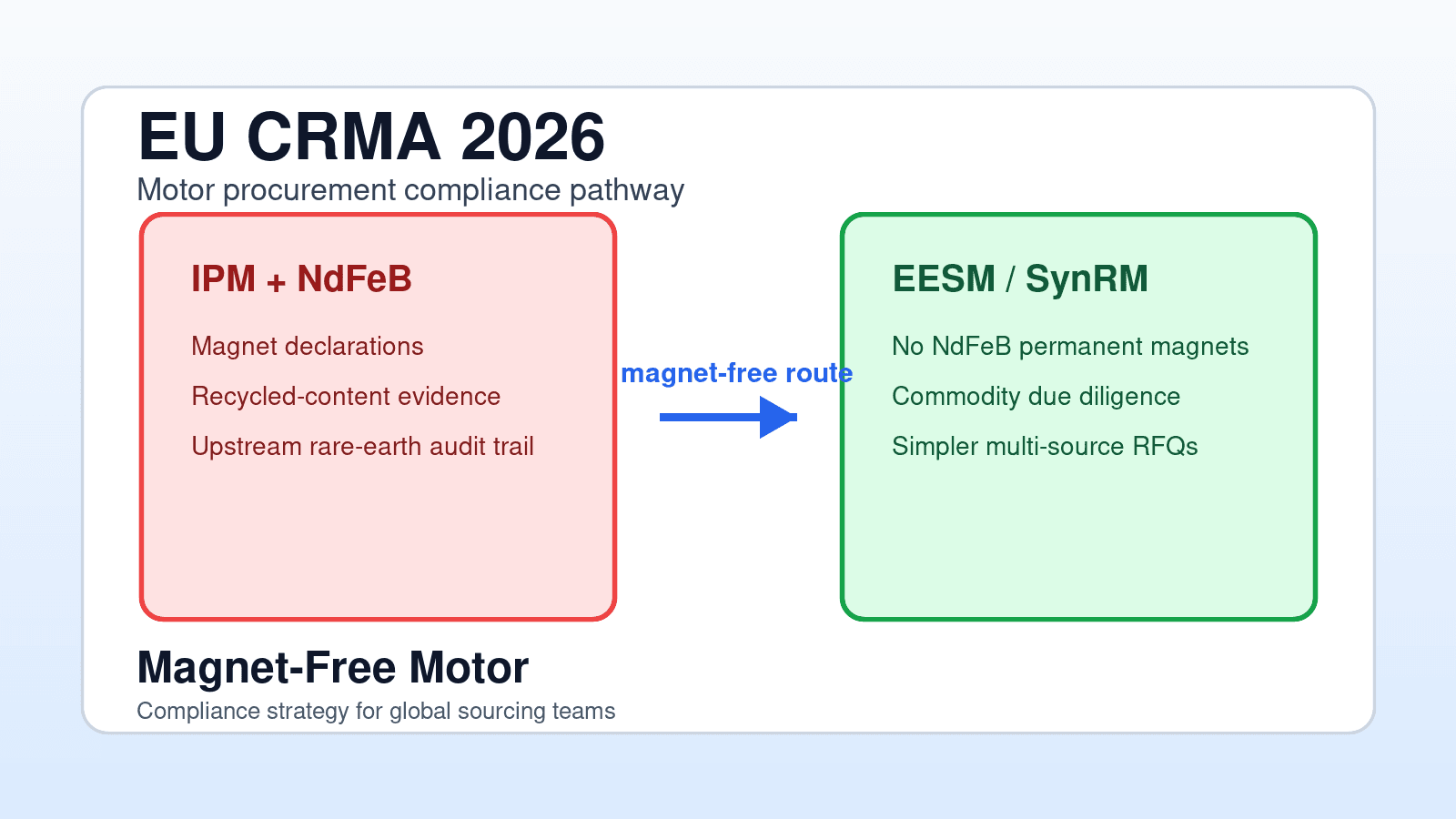
How the EU Critical Raw Materials Act (CRMA) affects 2026 motor procurement. Compare NdFeB tracking overhead against magnet-free EESM and SynRM alternatives.
Scope 3 Emissions & ESG: The Magnet-Free Motor Procurement Strategy for 2026
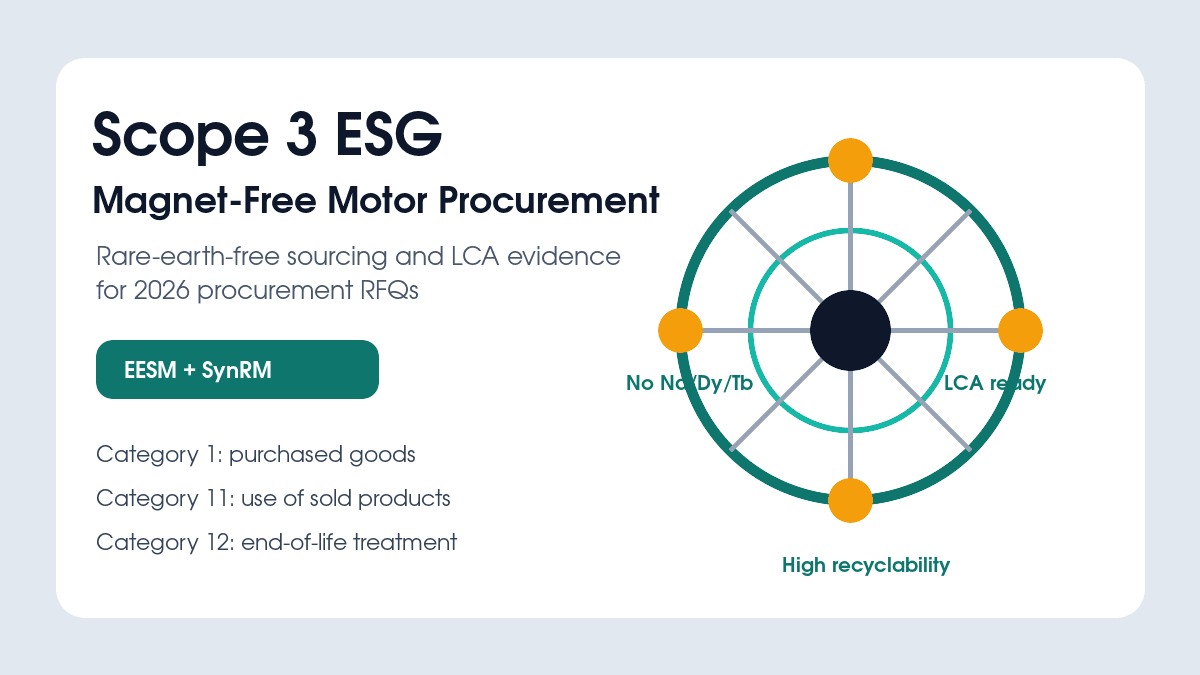
Use magnet-free motor sourcing to lower Scope 3 emissions, reduce rare-earth ESG risk, and request LCA evidence in 2026 procurement RFQs.