
EU CRMA 2026: Why Magnet-Free Motors Are the Safest Compliance Strategy
How the EU Critical Raw Materials Act (CRMA) affects 2026 motor procurement. Compare NdFeB tracking overhead against magnet-free EESM and SynRM alternatives.
For global procurement teams sourcing electric motors into, through, or alongside the EU market, 2026 sourcing programs now have a clear compliance constraint: the European Union's Critical Raw Materials Act (CRMA). The Act does not ban permanent-magnet motors, but it makes magnet origin, recycled-content evidence, and supplier documentation harder to ignore during RFQ release.
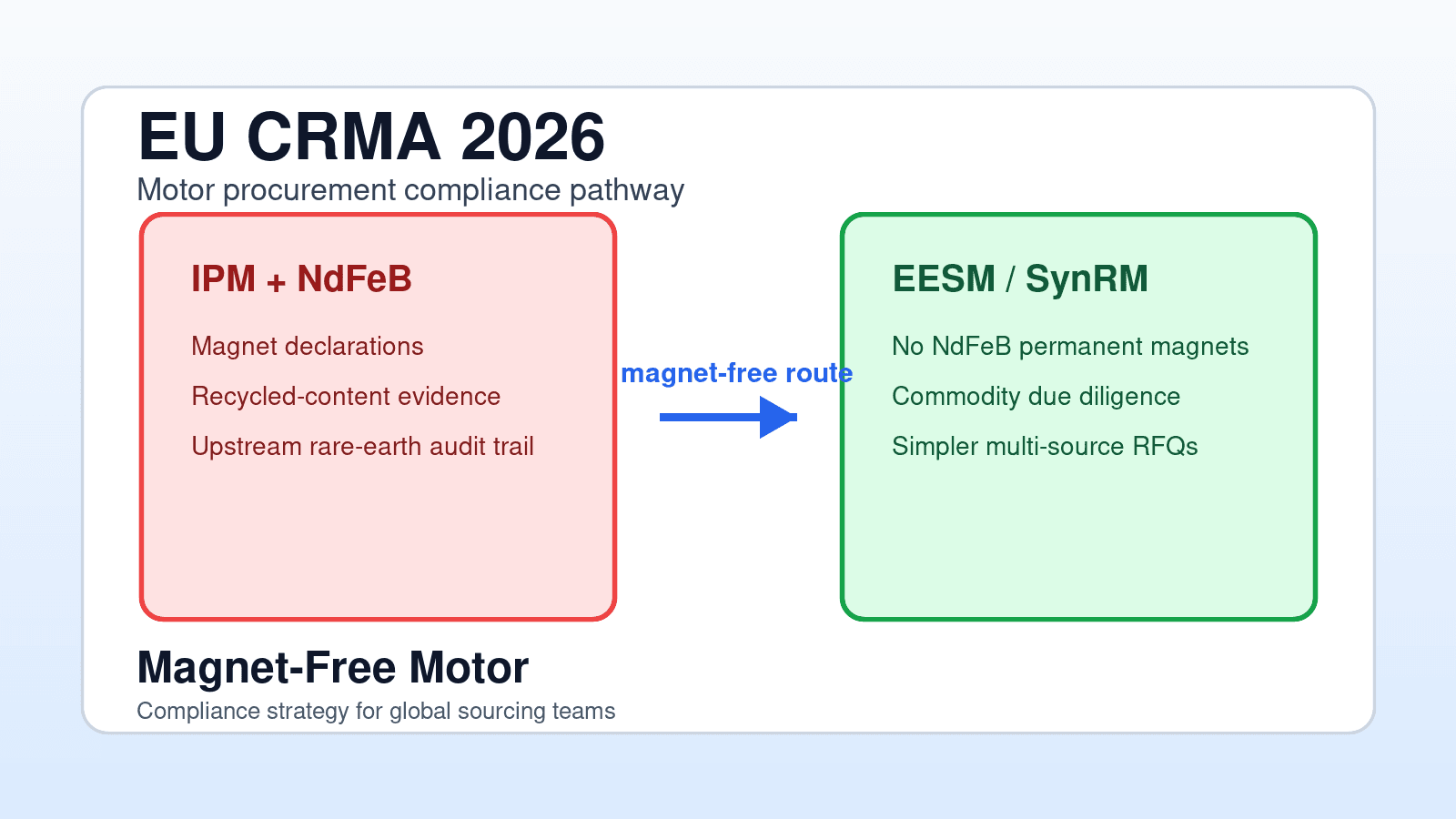
If your bill of materials (BOM) includes Interior Permanent Magnet (IPM) motors relying on Neodymium-Iron-Boron (NdFeB), your supply chain is exposed to the CRMA's permanent-magnet documentation path. This guide examines that procurement overhead and explains why shifting to Magnet-Free Motors - specifically Externally Excited Synchronous Motors (EESM) and Synchronous Reluctance Motors (SynRM) - is often the lower-risk compliance pathway when packaging, cooling, and inverter constraints can be solved.
This guide is designed for global buyers, procurement teams, importers, and supply chain managers evaluating 2026 motor sourcing programs.
Last reviewed: July 23, 2026. Scope: global procurement programs that must keep EU import, customer, or recycling evidence ready. This is not legal advice; final obligations depend on product category, magnet mass, seller role, and implementing acts in force at the time of sale.
Terminology: in procurement files, "magnet free motor" here means an electric motor architecture that removes NdFeB permanent magnets from the rotor, primarily EESM or SynRM.
Related internal inputs for a sourcing file: compare motor architectures in the EESM vs IPM procurement guide, review topology trade-offs in the SynRM vs EESM comparison, align efficiency claims with the IE5 standards compliance guide, and connect rare-earth reduction to reporting in the Scope 3 magnet-free procurement guide.
1. The Real Cost of CRMA Compliance for Motor Procurement
The EU CRMA is designed to reduce Europe's reliance on concentrated suppliers for strategic materials. For permanent magnets, the procurement-facing obligations center on transparency: material and origin information, recycled-content disclosure where required, removability and recyclability information, and EU benchmarks that can influence supplier qualification.
When you specify an IPM motor containing NdFeB magnets, your procurement team is no longer just buying a component; you are inheriting a compliance evidence burden. For an RFQ released in 2026, the implications are concrete:
- Traceability Declarations: You need credible country-of-origin and processing-chain evidence for neodymium, dysprosium, praseodymium, and other rare-earth inputs used in the rotor magnets.
- Recycled Content Disclosure and Future Threshold Risk: CRMA reporting focuses on recycled-content information for permanent magnets and gives EU institutions a route to set future minimum shares after assessment. Missing recycled-content data should therefore be treated as a supplier qualification risk, not as a paperwork footnote.
- Auditing Overhead: Tier-1 and OEM buyers increasingly need an audit trail through magnet alloy, oxide, and upstream suppliers, adding administrative overhead to the landed cost of the motor.
The problem is not just the spot price of rare earths; it is the cost of proving where they came from.
2. The Magnet-Free Bypass: EESM and SynRM
The most effective way to manage magnet-specific compliance exposure is to engineer it out of the product architecture. Magnet-free motors do this by removing the NdFeB permanent magnet from the rotor bill of materials.
Externally Excited Synchronous Motors (EESM)
EESMs replace permanent magnets with copper windings on the rotor, powered by a separate excitation current. Because the rotor uses electrical steel and copper instead of NdFeB magnets, the rare-earth magnet supply chain is eliminated.
- Compliance Status: Copper and electrical steel are not a free pass from all ESG or sourcing obligations, but they do not trigger the CRMA permanent-magnet declaration path.
- Procurement Value: You trade high regulatory risk for predictable LME (London Metal Exchange) copper pricing.
Synchronous Reluctance Motors (SynRM)
SynRMs rely entirely on the magnetic reluctance of a specialized steel rotor profile. There are no magnets and no copper windings on the rotor.
- Compliance Status: No permanent magnets and no rare-earth magnet exposure. Standard steel sourcing evidence still applies.
- Procurement Value: Extremely robust, maintenance-free industrial motors that completely bypass magnet-related supply chain volatility.
Compliance Pathway Visualized
3. Comparison Table: IPM Compliance Overhead vs. Magnet-Free
When conducting your TCO (Total Cost of Ownership) analysis for 2026 platforms, the cost is no longer just BOM materials. Procurement must model the compliance overhead.
| Sourcing & Compliance Dimension | IPM (NdFeB Magnets) | EESM (Copper-Wound Rotor) | SynRM (Steel Reluctance Rotor) | Impact on Procurement Teams |
|---|---|---|---|---|
| Permanent-Magnet CRMA Exposure | High (direct magnet reporting and recycled-content exposure) | Low (no NdFeB magnets; copper/steel due diligence remains) | Low (no permanent magnets; steel due diligence remains) | Magnet-free reduces magnet-specific legal and audit liabilities. |
| Material Origin Tracing | Required for magnet alloy and upstream rare-earth inputs where applicable | Standard ISO/ESG commodity tracing | Standard ISO/ESG commodity tracing | IPM requires a more specialized evidence chain. |
| Cost Volatility Profile | Unpredictable (export quotas, geopolitical) | Predictable (LME Copper fluctuations) | Highly Predictable (Electrical steel) | Magnet-free enables stable 3-5 year supply contracts. |
| Recycling Liability (EoL) | Complex (magnet removability, separation, and magnet stream evidence) | Standard (copper/steel recovery path) | Simple (steel rotor recovery path) | Magnet-free fits more easily into existing end-of-life vehicle/industrial recycling streams. |
| Supplier Redundancy | Low (Concentrated in one region) | High (Global copper/steel footprint) | High (Global steel footprint) | EESM/SynRM allows multi-sourcing strategies across NA/EU/Asia. |
| Engineering Trade-offs | Best peak torque density | Requires active rotor cooling, larger size | Lower power factor, requires larger inverter | You trade engineering packaging space for supply chain security. |
| Inverter Compatibility | Standard 3-phase | Requires dual-output (excitation) | Standard 3-phase (advanced software) | SynRM is a faster drop-in if the inverter firmware is updated. |
4. The Engineering Boundaries of the Magnet-Free Transition
While the compliance upside is strong, procurement teams must align with engineering to respect the boundary conditions of EESM and SynRM technologies.
EESM Boundary Conditions:
- Rotor Heat: Copper windings generate resistive heat on the rotor. The motor housing and cooling system (often requiring direct oil spray or hollow-shaft cooling) must be engineered to handle this. You cannot simply drop an EESM into an IPM cooling jacket and expect continuous high torque.
- Excitation Hardware: The DC current must cross a spinning gap. Ensure the supplier uses reliable brushless inductive exciters, as traditional carbon brushes introduce unacceptable maintenance intervals.
SynRM Boundary Conditions:
- Power Factor: SynRM motors have a lower power factor than IPMs. This means they draw more reactive current, which may require you to upsize the inverter's current rating to achieve the same mechanical power.
- Acoustics (NVH): Reluctance torque can introduce different torque ripple and acoustic noise profiles. Make sure NVH testing is included in your qualification.
5. The 2026 Magnet-Free Sourcing & RFQ Checklist
If you are shifting platforms to bypass CRMA overhead, your audit processes must change. Use this checklist during your supplier evaluation:
- Verify Excitation Tech (EESM): Does the supplier use maintenance-free brushless inductive excitation? (Reject traditional brush designs for harsh environments).
- Audit Rotor Thermal Dynamics: Have you reviewed the supplier's dyno data specifically for rotor temperature stabilization under continuous load?
- Check Inverter Integration: Does the supplier provide a validated inverter package, or provide the exact control algorithms needed for your Tier-1 drive?
- Review Winding Automation: Does the supplier utilize automated hairpin winding for the EESM rotor to ensure high slot-fill and repeatability?
- Confirm NVH Capabilities (SynRM): Has the supplier demonstrated active skewing or asymmetrical rotor laminations to mitigate torque ripple?
- Update Bill of Materials (BOM): Confirm that zero trace rare-earth elements are utilized in any secondary sensors or resolvers.
6. Frequently Asked Questions (FAQ)
Q: Does the CRMA ban permanent magnet motors?
A: No, the EU CRMA does not ban them. It creates permanent-magnet information, recycled-content disclosure, removability, and recyclability obligations, alongside broader strategic-material benchmarks. For procurement, that translates into more supplier evidence, documentation review, and audit preparation.
Q: If we switch to EESM to avoid the CRMA, do we sacrifice vehicle or machine efficiency?
A: Not automatically. A well-designed EESM can be competitive at high speeds (highway cruising for EVs or continuous high-speed industrial operation) because excitation can be reduced when full magnet flux is not needed. IPMs still hold an advantage in low-speed, peak-torque packaging scenarios.
Q: Can we use SynRM for traction motors in EVs?
A: SynRM is heavily used in industrial pumps, fans, and automation. For EVs, pure SynRM is rare due to lower power density and power factor. Instead, the EV industry focuses on EESM, or heavily optimized SynRM architectures with specialized inverter control.
Q: How does the cost of a magnet-free motor compare to an IPM in 2026?
A: At scale, EESM can approach cost parity with IPM. While EESM requires more complex winding machinery, the raw material basket is based on copper and steel rather than heavy rare-earth-doped NdFeB. When supplier evidence, audit time, and recycling documentation are included, the TCO case can favor magnet-free designs.
7. Sources and References
- European Commission - Critical Raw Materials Act: Official legislation outlining the tracking, reporting, and recycling requirements for permanent magnets entering the EU market. Review the European Commission CRMA details
- Regulation (EU) 2024/1252: The official CRMA legal text, including permanent-magnet information and recycling-related provisions. Read Regulation (EU) 2024/1252
- IEA (International Energy Agency) - Clean Energy Supply Chains: Global analysis of rare earth element geographic concentration and the push toward alternative motor architectures. Read the IEA Minerals Report
- London Metal Exchange (LME): The pricing benchmark for standard commodities like copper, which underpins predictable cost modeling for EESM rotor material compared with volatile rare earths. LME Copper Pricing
Is your supply chain ready for 2026 compliance mandates? Escaping rare-earth volatility and EU CRMA overhead requires a fundamental shift in motor architecture. Our engineering teams specialize in high-volume, rare-earth-free EESM and SynRM platforms designed for global compliance and localized manufacturing.
Contact our Product Engineering Team Today to evaluate magnet-free designs, review our automated hairpin capabilities, and reduce magnet-specific regulatory risk in your next product generation.
Author

More Posts
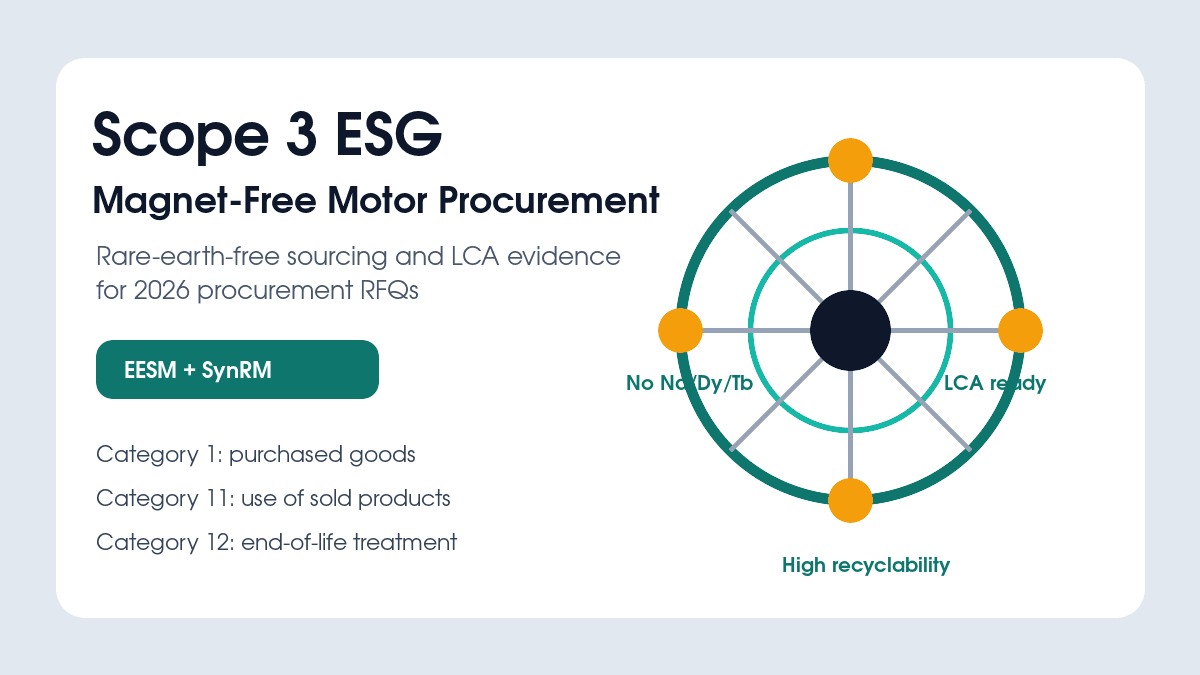
Scope 3 Emissions & ESG: The Magnet-Free Motor Procurement Strategy for 2026
Use magnet-free motor sourcing to lower Scope 3 emissions, reduce rare-earth ESG risk, and request LCA evidence in 2026 procurement RFQs.
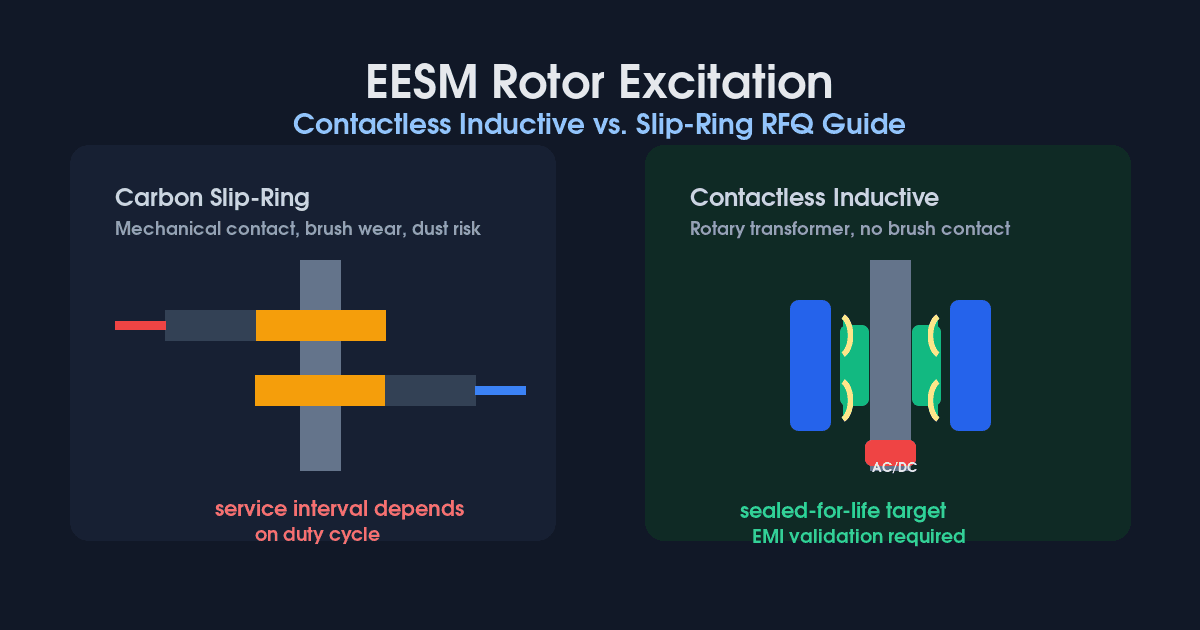
Contactless vs. Slip-Ring EESM Excitation: 2026 RFQ Guide
Compare contactless inductive and carbon slip-ring excitation for EESM. Use 2026 TCO, RPM, EMI, cooling, and supplier checks before issuing an RFQ.
IE5 SynRM vs. Induction Motors: A Comprehensive Efficiency Comparison
An engineering deep dive comparing IE5 Synchronous Reluctance Motors (SynRM) against traditional induction motors for heavy-duty industrial applications.