
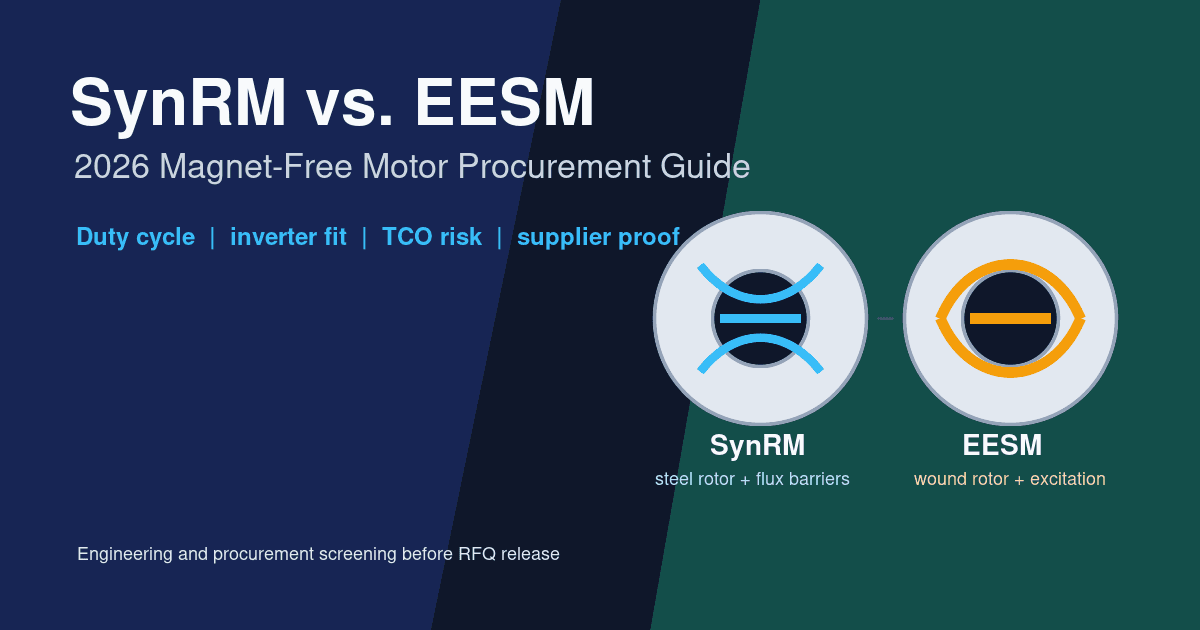
SynRM vs. EESM in 2026: The Ultimate Magnet-Free Motor Procurement Guide
Compare SynRM and EESM magnet-free motor options for 2026 procurement: duty cycles, inverter needs, TCO, supplier checks, and RFQ questions.
SynRM vs. EESM in 2026: The Ultimate Magnet-Free Motor Procurement Guide
As industrial electrification and electric vehicle (EV) production mature in 2026, the structural risks associated with rare-earth permanent magnets have forced OEMs and tier-one suppliers to rapidly transition toward magnet-free architectures. The debate is no longer whether to abandon Neodymium-Iron-Boron (NdFeB) magnets, but rather which magnet-free topology to adopt. For engineering and procurement teams, the decision largely narrows down to two dominant technologies: Synchronous Reluctance Motors (SynRM) and Externally Excited Synchronous Motors (EESM).
While both motors achieve the core objective of eliminating rare-earth supply chain vulnerabilities, they operate on fundamentally different physics, require distinct power electronics, and possess completely different efficiency curves. Choosing the wrong architecture for your application can lead to over-specified inverters, missed efficiency targets, or unnecessary maintenance liabilities.
This comprehensive guide is designed for buyers, procurement managers, distributors, importers, and technical engineers. It dissects the mechanical differences, supply chain economics, application boundaries, and supplier qualification criteria required to make a confident, data-driven sourcing decision between SynRM and EESM platforms.
Scope, Date, and Procurement Method
This guide was updated on July 17, 2026 for global OEM, industrial automation, and EV traction sourcing teams evaluating a magnet-free motor architecture before RFQ release. It compares SynRM and EESM by duty cycle, inverter requirements, thermal risk, manufacturability, TCO exposure, and supplier validation evidence.
Use it as a procurement and engineering screening framework, not as final electromagnetic design approval. Exact efficiency maps, overload limits, insulation class margins, and cooling requirements must still be validated against your load profile, ambient conditions, voltage platform, and supplier test reports.
If you already have a load profile, speed range, and target efficiency class, send the RFQ package to our engineering procurement team for a topology fit check before locking the motor and inverter specification.
1. Core Physics: How SynRM and EESM Eliminate Magnets
To understand the procurement and operational implications, we must first establish how these two motors generate torque without permanent magnets. In any AC synchronous motor, the stator generates a rotating magnetic field. The key differentiator is the rotor design.
Synchronous Reluctance Motors (SynRM)
A Synchronous Reluctance Motor operates on the principle of magnetic reluctance—the magnetic equivalent of electrical resistance. The rotor contains no magnets and no electrical windings. Instead, it is constructed from complex, highly engineered electrical steel laminations featuring precise air gaps (flux barriers).
When the stator generates a magnetic field, the steel rotor naturally aligns itself along the path of least magnetic resistance (reluctance), much like a compass needle aligning with the earth's magnetic poles. As the stator field rotates, the rotor is pulled along.
- The Engineering Advantage: Because the rotor contains no active current-carrying components (no copper wire, no magnets), there are absolute zero rotor copper losses ($I^2R$). This structural simplicity makes SynRM incredibly robust, inherently cool-running, and exceptionally efficient at partial loads.
- The Engineering Trade-off: SynRM inherently suffers from a lower power factor compared to permanent magnet motors. This means it requires more apparent power (higher current) from the inverter to generate the same torque, which can necessitate oversizing the Variable Frequency Drive (VFD) and thicker stator wiring to manage the increased stator copper losses.
Externally Excited Synchronous Motors (EESM)
An Externally Excited Synchronous Motor replaces the permanent magnets with a powerful electromagnet within the rotor. The rotor features dedicated slots wound with insulated copper wire. To create the necessary magnetic field, a separate DC "excitation current" is transferred to the spinning rotor, usually via an inductive brushless exciter or high-durability carbon slip rings.
- The Engineering Advantage: The magnetic flux of the rotor is not fixed; it is completely adjustable. The motor controller can pump maximum current into the rotor for massive low-end torque, and intelligently reduce the excitation current at high speeds. This active "field weakening" eliminates the drag (back-EMF) that plagues permanent magnet motors during high-speed cruising, resulting in superior high-speed efficiency.
- The Engineering Trade-off: Transferring power to a spinning rotor adds significant mechanical complexity. Furthermore, pushing constant DC current through the rotor's copper windings generates resistive heat (rotor copper losses), which mandates more aggressive thermal management solutions, such as active oil cooling of the rotor shaft.
Architecture Comparison Visualized
2. Efficiency Profiles: It's All About the Duty Cycle
You cannot accurately specify a motor without defining its exact duty cycle. The efficiency battle between SynRM and EESM is highly situational.
When SynRM Wins (Industrial & Low-to-Medium Speed): SynRM dominates in applications running at partial loads and low-to-medium speeds. In standard industrial processes—such as HVAC blowers, centrifugal pumps, and conveyors—motors rarely run at 100% capacity continuously. Because SynRM has zero rotor losses and no excitation overhead, its partial-load efficiency often exceeds IE5 Ultra-Premium standards. It runs significantly cooler than traditional induction motors, leading to longer bearing life and reduced maintenance intervals.
When EESM Wins (Traction & High Speed): EESM dominates in scenarios requiring a massive speed range, particularly automotive traction (electric vehicles) and high-speed spindles. While an EESM suffers slightly at low speeds due to the power required to maintain the rotor's magnetic field (excitation loss), it achieves unmatched efficiency at high highway cruising speeds. By actively turning down the rotor flux, the EESM eliminates the back-EMF drag, allowing the motor to spin freely and efficiently at 15,000+ RPM without straining the inverter.
3. Supply Chain Economics and Total Cost of Ownership (TCO)
The procurement logic for both motors is rooted in detaching from the volatile Neodymium and Dysprosium markets. However, their cost structures differ dramatically.
SynRM Economics:
- Initial Cost: The motor itself is relatively cheap to manufacture. It uses standard stator winding techniques and simple rotor stamping.
- Inverter Cost: SynRM cannot be run directly on grid power (across-the-line). It strictly requires an intelligent Variable Frequency Drive (VFD) equipped with specific SynRM control algorithms. Because of the lower power factor, procurement teams must often specify a VFD with a slightly higher amp rating than they would for an equivalent induction motor, which increases the total system CAPEX.
- TCO: Excellent. The energy savings from IE5+ efficiency usually pay back the VFD premium within 12 to 24 months in continuous industrial applications.
EESM Economics:
- Initial Cost: High manufacturing complexity. The rotor requires automated hairpin or continuous-wave winding, advanced balancing for high speeds, and the integration of a brushless inductive exciter or slip ring assembly.
- Inverter Cost: Requires a highly specialized dual-output inverter. The main output handles the standard 3-phase AC for the stator, while a secondary circuit precisely modulates the DC excitation current to the rotor.
- TCO: Highly dependent on volume. At low volumes, EESM is expensive. However, major automotive OEMs have invested billions in automated EESM winding lines. At scale, EESM offers a predictable cost structure entirely decoupled from rare-earth geopolitics, driven purely by the stable, globally traded copper and steel markets.
4. Structured Comparison: SynRM vs. EESM
The following table breaks down the crucial differences across six primary engineering and procurement dimensions:
| Evaluation Dimension | Synchronous Reluctance (SynRM) | Externally Excited (EESM) |
|---|---|---|
| Rotor Construction | Cold-rolled electrical steel, precise flux barriers, no windings. | Complex wound copper rotor with heavy-duty insulation & retention. |
| Rare-Earth Metals | Zero (100% Magnet-Free). | Zero (100% Magnet-Free). |
| Peak Efficiency Zone | Exceptional at low speeds and partial load operations. | Superior at high speeds and high-load cruising (field weakening). |
| Control Requirements | Standard VFD with SynRM software profile (higher apparent power). | Specialized dual-output inverter (3-phase AC + DC excitation loop). |
| Thermal Management | Very low rotor heat; standard air or liquid jacket cooling is sufficient. | High rotor heat; often requires advanced direct oil-spray cooling on the shaft. |
| Maintenance Profile | Practically maintenance-free; extremely long bearing life due to cool rotor. | Low maintenance if brushless exciter used; periodic brush replacement if slip-rings used. |
5. Application Boundaries: Where to Spec Each Motor
To avoid costly over-engineering, align your procurement strategy with the natural strengths of the topology:
Specify SynRM For:
- Pumps, Fans, and Compressors: The quadratic load curve of these applications perfectly matches SynRM's partial-load efficiency peaks.
- Extruders and Conveyors: High continuous torque requirements where the motor operates below base speed.
- Industrial Retrofits: Upgrading aging IE2/IE3 induction motors to IE5 standards to meet stringent 2026 ESG and energy mandates.
Specify EESM For:
- Electric Vehicle (EV) Traction: Primary drive units for passenger EVs, long-haul commercial trucks, and e-buses where highway cruising efficiency dictates battery range.
- High-Speed Industrial Spindles: CNC machinery and centrifuges requiring rapid acceleration to 20,000+ RPM without magnet degradation.
- Heavy-Duty Mobile Equipment: Mining and construction electrification where massive low-end torque must be combined with high-speed transit capabilities.
6. Supplier Qualification & Procurement Checklist
When launching an RFQ for magnet-free motors, the supplier vetting process must be rigorous. Ensure your technical sourcing team covers these critical checkpoints:
- Application Matching: Has the supplier mapped the motor's efficiency island against your specific operational duty cycle, rather than quoting a generic "peak efficiency" number?
- Inverter Compatibility (SynRM): Does the supplier guarantee that their SynRM is fully compatible with your preferred Tier-1 VFD brand, or do they mandate a proprietary drive?
- Excitation Reliability (EESM): If specifying EESM, what is the exact excitation mechanism? If slip rings are used, what is the validated lifespan of the carbon brushes in harsh environments? If brushless, ask for EMI and thermal validation reports.
- Rotor Integrity (EESM): How does the supplier secure the heavy copper windings on the EESM rotor against centrifugal expansion at high RPMs? (Look for carbon-fiber over-wraps or high-strength epoxy potting).
- Power Factor Sizing (SynRM): Have your electrical engineers verified the required apparent power (kVA) rating for the inverter to prevent unexpected trips due to SynRM's lower power factor?
- Thermal Validation: Has the supplier provided thermal run-down data proving that rotor copper losses (EESM) or stator copper losses (SynRM) will not exceed insulation class limits under continuous stall or peak-load conditions?
7. Frequently Asked Questions (FAQ)
Q: If neither motor uses rare earths, which one is cheaper to manufacture?
A: Generally, SynRM is much cheaper to manufacture because the rotor is purely stamped steel with no complex winding or excitation hardware. EESM requires specialized automated machinery to wind the rotor efficiently, making it more capital-intensive at the factory level.
Q: Can a SynRM be run "Direct-on-Line" (DOL) without an inverter?
A: No. Pure SynRM motors cannot start independently on grid power. They strictly require a Variable Frequency Drive. There are hybrid variants (Line-Start SynRM) that include an aluminum squirrel cage specifically for DOL starting, but true, high-efficiency SynRM requires a drive.
Q: Are EESM motors heavier than permanent magnet motors?
A: Yes, marginally. Because copper windings cannot generate the extreme magnetic flux density of NdFeB magnets in the same spatial volume, an EESM is typically 5% to 10% larger and heavier than an equivalent IPM motor to produce the same peak torque.
Q: Which technology is more resilient in high-temperature environments?
A: SynRM. Because there are no magnets to demagnetize and no rotor windings to melt or short-circuit, SynRM handles high ambient temperatures exceptionally well, provided the stator insulation is properly rated.
8. Verifiable Sources and References
To keep this procurement guide auditable, the regulatory and technology boundaries above are cross-checked against the following sources. Treat vendor pages as architecture examples, then require project-specific test data from the supplier before award.
- European Commission - Electric Motors: Ecodesign requirements for electric motors and variable speed drives, including IE efficiency classes and VSD information requirements. Read the electric motors product page
- IEA Critical Minerals: Supply chain context for critical minerals and the strategic pressure behind rare-earth reduction in electrified equipment. View IEA critical minerals analysis
- ABB Synchronous Reluctance Motors: Manufacturer reference for IE5/IE6 SynRM positioning, drive pairing, and magnet-free industrial applications. Review ABB SynRM motors
- Valeo Rare Earth Free Electric Motor: Manufacturer reference for automotive EESM / rare-earth-free traction motor development. Review Valeo rare-earth-free motor information
Related Procurement Resources
- IE5 SynRM vs. Induction Motors — Use this when the real decision is SynRM retrofit versus a premium induction motor.
- EESM vs. IPM Motors: Procurement Comparison — Use this when the EV traction decision still includes permanent magnet IPM motors.
- Rare Earth Price Forecast 2026 — Use this to frame commodity and sourcing exposure before quoting magnet-free alternatives.
Looking for the Right Magnet-Free Solution for Your Next Project?
Navigating the transition away from rare-earth magnets requires deep technical expertise and a secure supply chain. Our engineering team designs and manufactures both ultra-efficient SynRM platforms for industrial automation and high-performance EESM drives for global electrification projects.
Contact our Engineering Procurement Team today to discuss your load profile, request technical drawings, or initiate an RFQ for our latest 2026 magnet-free motor lineups.
Author

More Posts
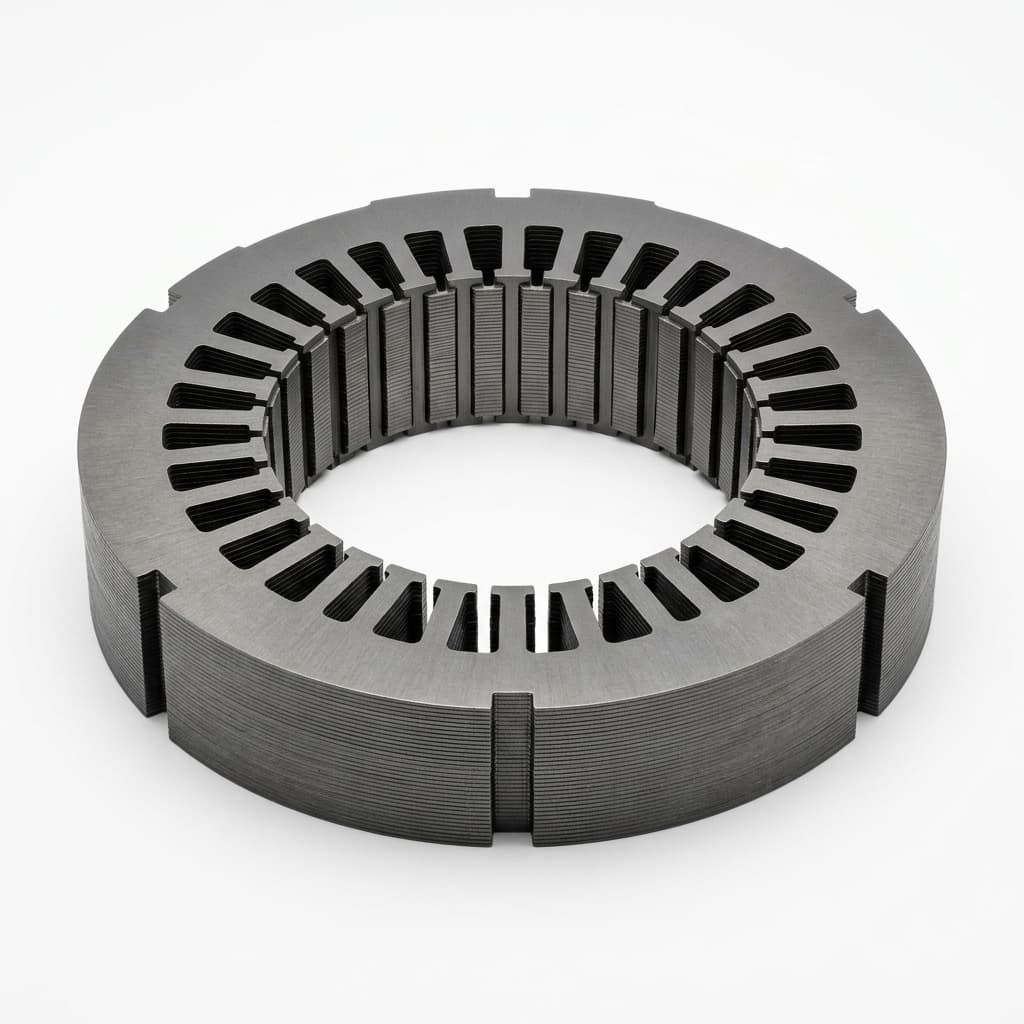
Rare Earth Price Forecast 2026: Why Motor Manufacturers are Abandoning Neodymium
A deep dive into the 2026 rare-earth pricing forecast. Learn why volatile Neodymium and Dysprosium markets are forcing OEMs to adopt magnet-free motors.
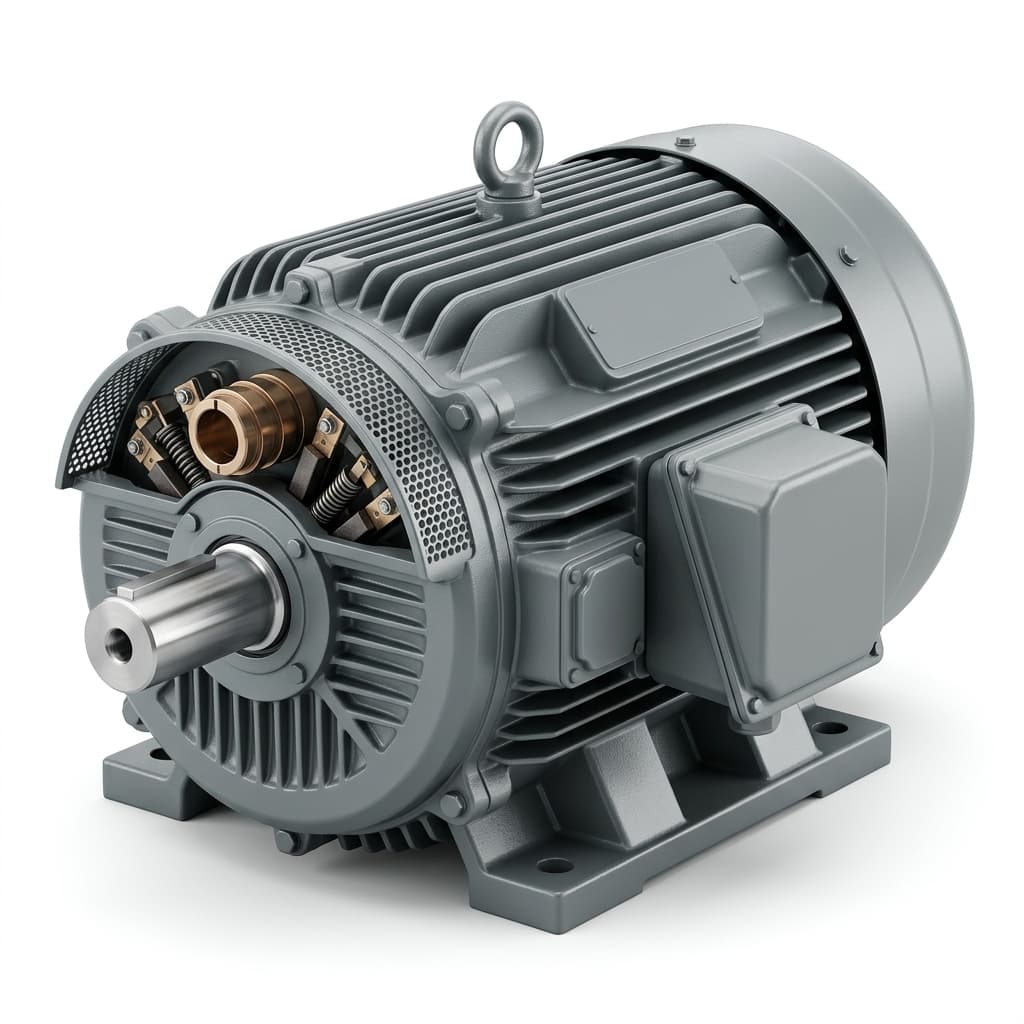
Why Magnet-Free Motors Are the Future of Industrial Automation
Discover how magnet-free motors like SynRM and WRSM are transforming industrial automation by eliminating rare-earth risks and boosting IE5 efficiency.
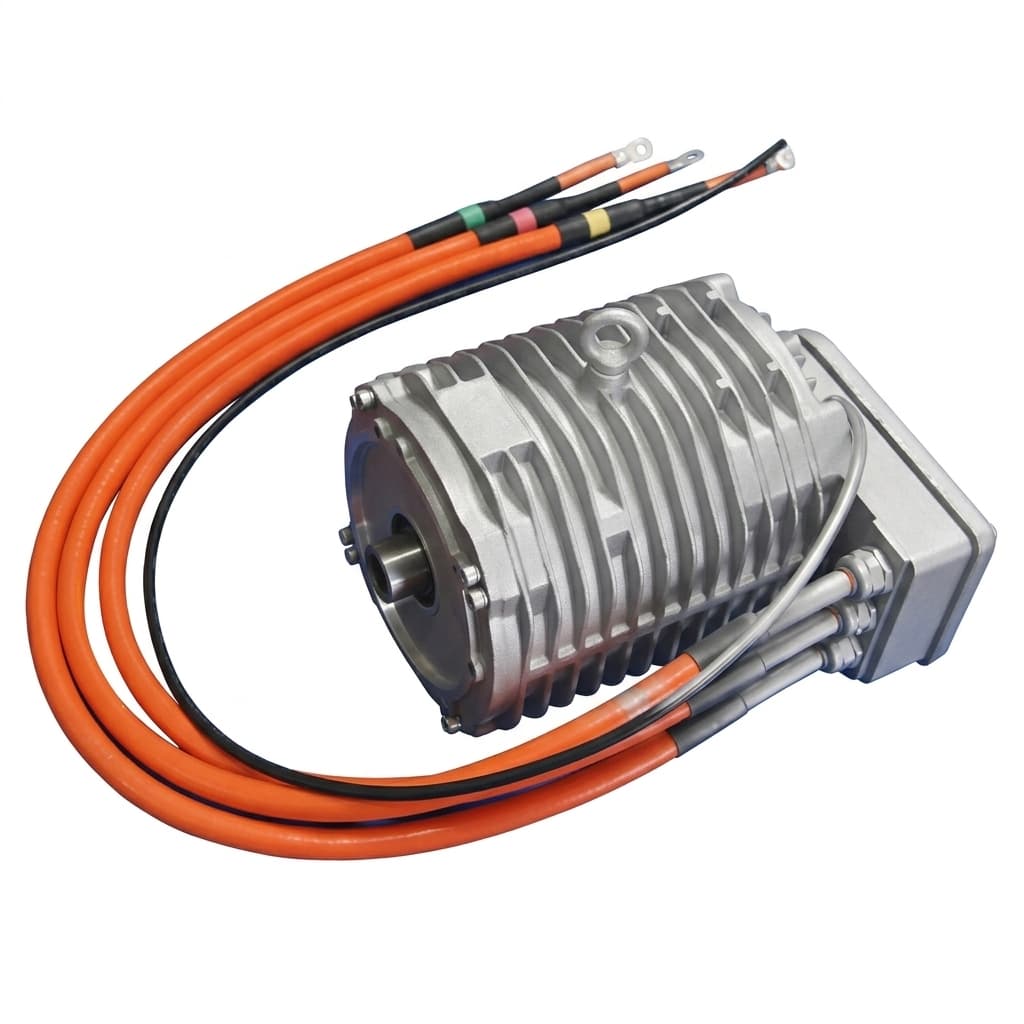
The Industry Shift to Rare-Earth-Free Traction Drives: Lessons from Global EV Leaders
Global automakers are moving away from rare-earth permanent magnets. Explore the engineering behind the new wave of magnet-free EV traction motors.