
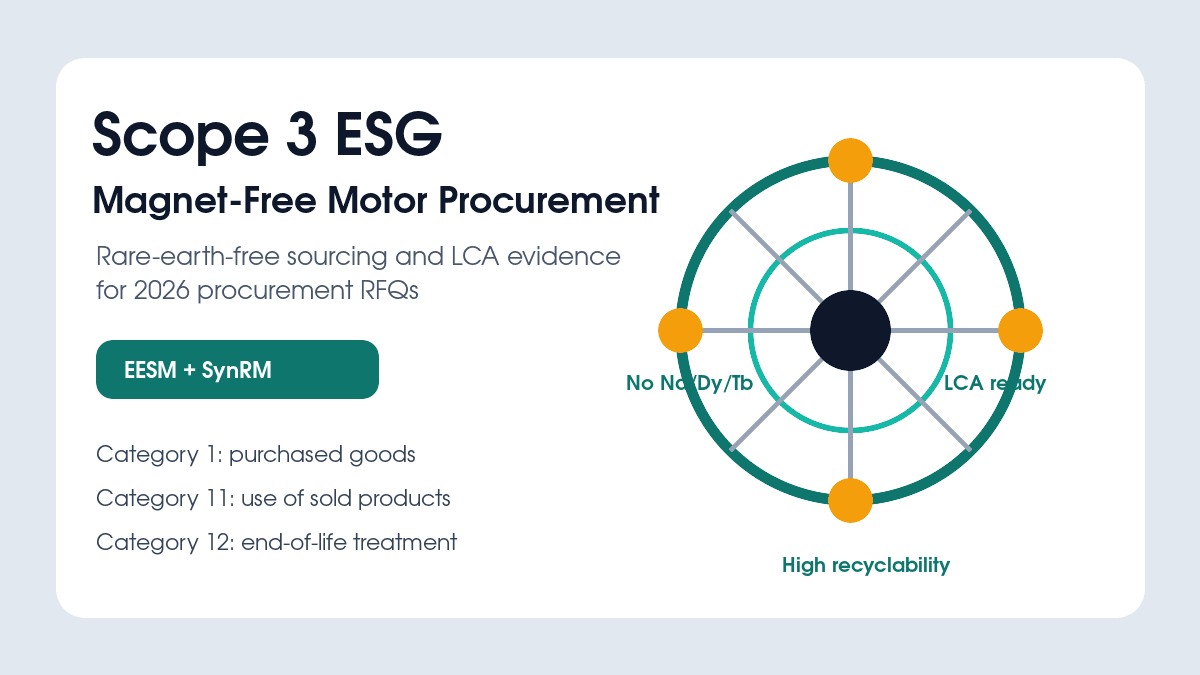
Scope 3 Emissions & ESG: The Magnet-Free Motor Procurement Strategy for 2026
Use magnet-free motor sourcing to lower Scope 3 emissions, reduce rare-earth ESG risk, and request LCA evidence in 2026 procurement RFQs.
In 2026, B2B procurement has fundamentally shifted. While unit cost, lead time, and operational efficiency remain critical, a new mandate has taken center stage for global buyers, distributors, and OEMs: Environmental, Social, and Governance (ESG) compliance and Scope 3 emissions reporting.
For decades, the standard for high-efficiency electric motors in industrial automation, HVAC, and electric vehicles (EVs) has been the Interior Permanent Magnet (IPM) motor. IPMs deliver exceptional torque density and low-speed efficiency. However, they carry a hidden, massive environmental cost embedded in their reliance on rare-earth elements (REEs) like Neodymium (Nd), Dysprosium (Dy), and Terbium (Tb).
As customer scorecards and regional disclosure regimes tighten carbon accounting, procurement teams can no longer ignore the upstream footprint of their supply chains. The Corporate Sustainability Reporting Directive (CSRD) in Europe is already shaping supplier data requests, while the U.S. SEC climate-disclosure rule remains a moving target after the SEC proposed rescission of its 2024 rule in 2026. This pressure has accelerated the adoption of magnet-free motors, specifically Externally Excited Synchronous Motors (EESM) and Synchronous Reluctance Motors (SynRM).
This comprehensive guide is designed for procurement managers, sustainability officers, and application engineers. It breaks down how transitioning to magnet-free motors impacts your Life Cycle Assessment (LCA), reduces your Scope 3 emissions, and future-proofs your sourcing strategy against escalating ESG scrutiny.
Scope and limits, reviewed July 21, 2026: use this guide for global RFQ screening, supplier-question design, and early architecture trade-off work. It is not a substitute for a supplier-specific ISO 14040/14044 LCA, certified product carbon footprint, duty-cycle efficiency map, or jurisdiction-specific legal advice. If you need topology context before building the RFQ, pair this article with the EESM vs. IPM procurement guide, the SynRM vs. EESM sourcing comparison, the rare-earth price exposure forecast, and the VFD compatibility checklist.
1. Understanding Scope 3 Emissions in Motor Procurement
To understand why magnet-free motors are becoming the default ESG choice, we must first define how motor procurement impacts corporate carbon accounting. The Greenhouse Gas (GHG) Protocol categorizes emissions into three scopes. For an OEM integrating electric motors into sold equipment, much of the procurement decision appears in Scope 3 (Value Chain Emissions). For a factory operator installing motors in its own facilities, the purchased motor footprint remains Scope 3 Category 1, but operating electricity is usually Scope 2 rather than Category 11. Confirm the boundary with your own GHG inventory owner before assigning savings to a public target.
Scope 3 is notoriously difficult to track and reduce because it involves emissions outside of your direct control. When you purchase an industrial motor for resale, product integration, or customer-facing equipment programs, it can impact three primary Scope 3 categories:
- Category 1: Purchased Goods and Services. This is the "cradle-to-gate" manufacturing footprint. It includes the mining of raw materials, refining, component manufacturing, and final assembly of the motor before it reaches your facility.
- Category 11: Use of Sold Products. If you are an OEM integrating the motor into a machine (like a compressor or an EV) and selling it, the electricity that motor consumes over its 15-20 year lifespan falls here. This is often the largest portion of a motor's lifetime carbon footprint.
- Category 12: End-of-Life Treatment of Sold Products. What happens when the motor dies? Can it be recycled easily, or does it end up in a landfill because extracting the toxic rare-earth magnets is economically unviable?
Historically, buyers solely focused on Category 11 (efficiency). By specifying IPM motors, they minimized the energy used during operation. However, modern ESG reporting requires a holistic Life Cycle Assessment (LCA). When you factor in Category 1 and Category 12, the environmental argument for IPM motors begins to collapse, paving the way for EESM and SynRM technologies.
2. The Manufacturing Footprint: The Hidden Cost of Rare Earths (Category 1)
The most glaring difference between an IPM motor and a magnet-free motor (like EESM) lies in the rotor materials. IPM motors require permanent magnets; EESMs use electrical steel and copper windings.
The Ecological Impact of NdFeB Magnets
The mining and refining of Neodymium-Iron-Boron (NdFeB) magnets can carry high site-specific environmental burdens. Depending on ore body, process route, grid mix, and waste management controls, rare-earth extraction and separation can involve:
- High tailings and waste-rock management loads.
- Acidic wastewater and chemical reagent handling.
- Radioactive byproduct controls where thorium or uranium are present in the ore.
From a purely carbon perspective, the energy required to extract, separate, and smelt heavy rare earths like Dysprosium—used to give magnets high-temperature stability—is astronomical. This massive energy expenditure is front-loaded into your Category 1 Scope 3 emissions the moment you issue a Purchase Order for an IPM motor.
The Magnet-Free Alternative
In contrast, magnet-free motors rely on commodity metals: Copper, Aluminum, and Electrical Steel. While copper mining has its own environmental impact, the global copper supply chain is vastly more mature, decentralized, and heavily regulated. More importantly, secondary (recycled) copper is widely available. It is entirely possible in 2026 to procure EESM motors wound with a high percentage of recycled copper, drastically lowering the Category 1 emissions profile.
By specifying magnet-free motors, procurement teams instantly eliminate the most toxic and carbon-intensive segment of their motor supply chain. You remove the ESG risk of sourcing materials from regions with poor labor and environmental oversight, and you secure a much lower "cradle-to-gate" carbon footprint.
Life Cycle Assessment (LCA) Boundary Visualization
3. The Use Phase: Balancing Efficiency and Carbon Intensity (Category 11)
Detractors of magnet-free motors often point out that, in certain duty cycles, IPM motors are marginally more efficient. Because permanent magnets generate a flux field without consuming electricity, there are no "rotor copper losses" (heat generated by resistance in the rotor windings).
If an EESM is 1-2% less efficient at peak torque than an IPM motor, doesn't that extra energy consumption over a 15-year lifespan negate the manufacturing carbon savings?
The answer is highly dependent on two factors: the Duty Cycle and the Grid Mix.
- The Duty Cycle Factor: Efficiency is not a single number; it is a map. While IPMs excel at low speeds and high torque, they suffer at high speeds. To spin an IPM motor fast, the inverter must inject "field-weakening" current to fight the permanent magnets, which wastes massive amounts of energy. EESMs, however, can simply dial down their rotor current at high speeds. For applications involving continuous high-speed cruising (like highway EVs or high-speed industrial spindles), an EESM is actually more energy-efficient over the total duty cycle than an IPM.
- The Grid Carbon Intensity Factor: As global power grids transition to renewables (wind, solar, hydro), the carbon intensity of a kilowatt-hour (kWh) of electricity is plummeting. As the grid gets greener, the carbon penalty of a slight use-phase efficiency drop decreases. Conversely, the carbon and toxicity penalty of mining rare earths remains fixed. In LCA models projected out to 2035, the upfront manufacturing emissions (where magnet-free wins) represent an increasingly dominant share of the motor's total lifetime GHG emissions.
For procurement teams, this means that specifying highly engineered EESM or SynRM motors provides an optimal balance: maintaining IE4/IE5 level efficiencies while drastically slashing the Category 1 manufacturing footprint.
4. End-of-Life and Circularity: The Category 12 Advantage
The final phase of a Life Cycle Assessment is disposal. The Circular Economy is a massive component of modern ESG scoring, heavily penalizing products that end up in landfills.
The Problem with Recycling IPM Motors
Recycling permanent magnets is technically possible but economically unviable at scale today. NdFeB magnets are brittle and heavily glued or embedded deeply into the rotor laminations to withstand centrifugal forces. Extracting them requires shredding the rotor and using complex hydro-metallurgical chemical baths to separate the rare earths from the steel. Often, the magnets simply shatter, and the rare earths are lost to the steel recycling slag. The cost of recovering the neodymium frequently exceeds the spot price of newly mined material.
The Magnet-Free Circularity Win
EESM and SynRM motors are inherently circular. They are composed entirely of standard industrial metals: copper, aluminum, and steel. The recycling industry has spent a century perfecting the separation of copper wire from steel cores. When a magnet-free motor reaches its end of life, it has high, predictable scrap value. The copper windings can be melted down and infinitely recycled without degrading their conductive properties.
From an ESG reporting standpoint, specifying magnet-free motors lets procurement ask for simpler, more auditable end-of-life evidence. The strongest claim is not a blanket "100% recyclable" statement; it is a supplier-backed disassembly and material-recovery plan with steel, copper, and aluminum mass fractions documented for your product carbon footprint.
5. ESG & LCA Impact Comparison Matrix
For purchasing managers building a business case for the transition, the following table quantifies the ESG and Life Cycle differences between motor topologies.
| Environmental / ESG Metric | IPM (Interior Permanent Magnet) | SynRM (Synchronous Reluctance) | EESM (Externally Excited) |
|---|---|---|---|
| Raw Material Toxicity Risk | High (Acidic tailings, radioactive byproducts) | Low (Electrical steel, minimal Cu) | Low to Moderate (High Cu volume, steel) |
| Upstream Carbon Footprint (Cat 1) | Highest (Due to REE extraction & refining) | Lowest (No magnets, minimal rotor Cu) | Moderate (No magnets, standard Cu/Fe processing) |
| Use-Phase Efficiency (Cat 11) | Excellent (Except at high-speed field weakening) | Good (High efficiency, but lower power factor) | Excellent (Superior high-speed cruising efficiency) |
| End-of-Life Recyclability (Cat 12) | Poor (Magnets difficult/costly to extract) | Excellent (Pure steel/aluminum, highly circular) | Excellent (Standard Cu/Fe separation processes) |
| Supply Chain Governance Risk | High (Concentrated geopolitical supply) | Low (Globally diversified steel) | Low (Globally diversified Cu/Steel) |
| Overall ESG Compliance Profile | Challenging (Requires intense traceability) | Highly Favorable | Highly Favorable |
(Note: SynRM motors offer the absolute lowest manufacturing footprint as their rotors often contain no copper at all, relying purely on the geometry of the steel laminations to generate torque. However, EESMs offer higher power density, making them the preferred magnet-free choice for demanding EV and heavy-industrial applications.)
If a bidder cannot supply motor efficiency maps, recycled-material declarations, or a product-level carbon footprint, pause the award decision and request an LCA evidence review before committing the program to a permanent-magnet architecture.
6. The 2026 ESG Motor Procurement Checklist
If your organization has mandated a reduction in Scope 3 emissions, you cannot simply ask a supplier for a "green motor." You must audit their engineering and supply chain practices. Use this checklist during your next RFQ to ensure your magnet-free transition yields real ESG benefits:
- Verify Magnet-Free Architecture: Explicitly confirm the motor utilizes zero rare-earth materials (no Nd, Dy, Tb, Pr). Ensure there are no "hybrid" ferrite magnets hidden in the rotor design if pure circularity is the goal.
- Request LCA Documentation: Does the supplier provide a formal Life Cycle Assessment (ISO 14040/14044 compliant) detailing the CO2-equivalent footprint per kilowatt of motor power?
- Audit Copper Sourcing: For EESM motors, copper is the primary environmental variable. Ask the supplier about their copper supply chain. Do they utilize secondary (recycled) copper? Are their primary copper mines certified by the Copper Mark (an ESG framework for responsible production)?
- Assess Excitation Maintenance (For EESM): If specifying an EESM, investigate the excitation method. Brushless inductive exciters are maintenance-free and generate no conductive dust, improving the environmental safety of the operating facility compared to traditional carbon brushes.
- Evaluate End-of-Life Disassembly: Does the supplier design for disassembly (Eco-design)? Can the stator and rotor copper be easily separated from the electrical steel laminations without extreme chemical shredding?
- Inverter Matching Efficiency: A magnet-free motor is only as efficient as its drive. Ensure the supplier provides optimized control algorithms (or a paired dual-output inverter) to maximize the Category 11 use-phase efficiency.
7. Frequently Asked Questions (FAQ)
Q: Will switching to magnet-free motors hurt our energy efficiency metrics (Scope 2 or Category 11)? A: Not automatically. Modern EESMs and SynRMs can reach IE4 and IE5 super-premium efficiency levels, but the result depends on the torque-speed map, drive pairing, cooling design, and duty cycle. Require supplier efficiency maps before claiming Scope 2 or Category 11 reductions.
Q: We are a mid-sized OEM. Why should we care about Scope 3 emissions now? A: Even if you are not directly regulated yet, your largest customers likely are. Enterprise companies and government buyers are now demanding carbon footprint data from all their suppliers. If you cannot provide a low-carbon, rare-earth-free product, you risk losing bids to competitors who have optimized their ESG profiles.
Q: Are magnet-free motors more expensive upfront? A: It depends on volume, power density, cooling complexity, and whether the inverter is included. EESM copper and excitation hardware can raise bill-of-material cost, but eliminating rare-earth magnets reduces exposure to neodymium and dysprosium price shocks. Compare total landed cost over the supply agreement, not only the first purchase order.
Q: What is the main engineering challenge when moving from IPM to EESM? A: Rotor thermal management and inverter integration. EESM rotors generate heat (copper losses) that IPM rotors do not, requiring advanced cooling (like internal shaft oil cooling). Additionally, your standard 3-phase inverter cannot drive an EESM; you need a specialized drive capable of providing the DC excitation current to the rotor.
8. Sources & References
To support your internal ESG business case, refer to these industry standards and academic life-cycle assessments:
- Chalmers University of Technology - Motor LCA Research: Comparative life-cycle research across permanent-magnet, externally excited, and reluctance electric machines. Read the Chalmers publication record.
- Greenhouse Gas Protocol (GHG Protocol): The global standard for measuring and managing emissions, specifically the definitions and boundaries of Scope 3 Categories 1, 11, and 12. GHG Protocol Corporate Value Chain Standard.
- IEA Global Supply Chains of EV Batteries (and Motors): Highlights the geographic concentration and ESG risks associated with critical minerals like Neodymium and Dysprosium. IEA Critical Minerals Reports.
- VTT Technical Research Centre - Eco-Design: European research on the circular economy and recyclability rates of electrical machines at end-of-life. VTT Research on Circular Economy.
- U.S. Securities and Exchange Commission: Current status context for U.S. climate disclosure uncertainty after the SEC proposed rescission of the 2024 climate-related disclosure rule in 2026. SEC proposes rescission of climate-related disclosure rules.
Ready to align your motor procurement with your corporate ESG targets? Eliminating rare-earth dependency is the fastest way to slash your supply chain's carbon footprint and secure a predictable, sustainable sourcing strategy. Our engineering team designs highly efficient, magnet-free EESM and SynRM solutions tailored for high-volume OEMs and heavy industrial applications.
Contact our Technical Sales Team to request efficiency maps, Life Cycle Assessment data, and evaluate how a magnet-free architecture can transform your next product generation.
Author

More Posts
IE5 Motor Efficiency Standards Explained: Do You Need Magnets to Comply?
Understand the IE5 Ultra-Premium Efficiency standard. Learn how Synchronous Reluctance Motors (SynRM) achieve IE5 compliance without rare-earth magnets.
Rare Earth Price Forecast 2026: Why Motor Manufacturers are Abandoning Neodymium
A deep dive into the 2026 rare-earth pricing forecast. Learn why volatile Neodymium and Dysprosium markets are forcing OEMs to adopt magnet-free motors.
The Industry Shift to Rare-Earth-Free Traction Drives: Lessons from Global EV Leaders
Global automakers are moving away from rare-earth permanent magnets. Explore the engineering behind the new wave of magnet-free EV traction motors.