
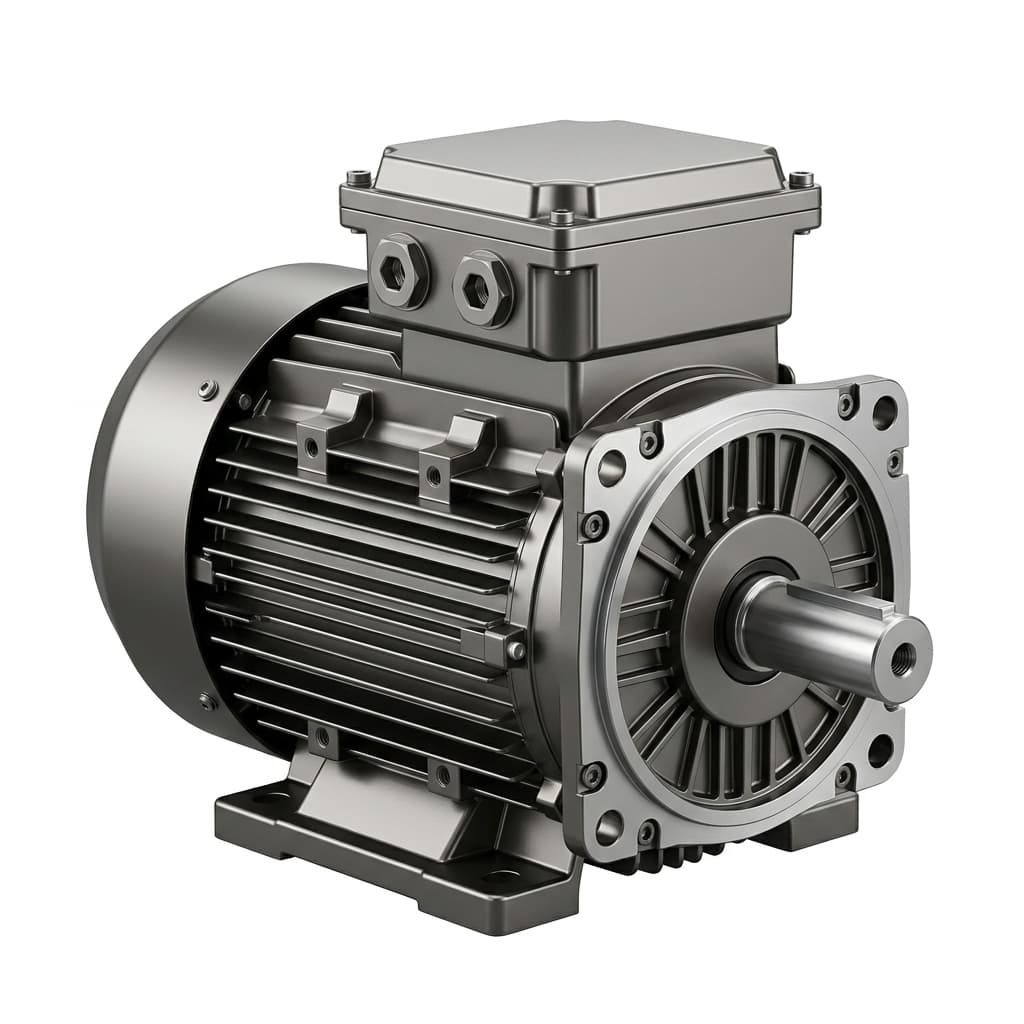
IE5 Motor Efficiency Standards Explained: Do You Need Magnets to Comply?
Understand the IE5 Ultra-Premium Efficiency standard. Learn how Synchronous Reluctance Motors (SynRM) achieve IE5 compliance without rare-earth magnets.
[!NOTE] Executive Summary (TL;DR):
- The Goal: Achieving IE5 Ultra-Premium Efficiency requires a ~20% reduction in motor losses compared to IE4.
- The Problem: Traditional AC Induction motors suffer from unavoidable rotor I²R heating losses.
- The Engineering Insight: Synchronous Reluctance Motors (SynRM) can target IE5 efficiency without rare-earth magnets by removing rotor I²R losses; final temperature and efficiency claims still need test data for the specific frame, load, and VFD setup.
IE5 Motor Efficiency Standards Explained: Do You Need Magnets to Comply?
Across the globe, industrial energy regulations are tightening. The European Union's Ecodesign Directive, the US Department of Energy (DOE) mandates, and China's GB 18613 standard are all aggressively pushing industrial facilities to upgrade their electric motors. Electric motors account for nearly 45% of global electricity consumption, making them the primary target for carbon reduction initiatives.
While IE3 (Premium Efficiency) was the baseline for the past decade, the new gold standard for high-performance applications is IE5 Ultra-Premium Efficiency.
Many engineers incorrectly assume that reaching IE5 requires the use of expensive Permanent Magnet Synchronous Motors (PMSM). This is categorically false. Let us look at how magnet-free technology achieves IE5 compliance while dramatically lowering the Total Cost of Ownership (TCO).
What is IE5 Ultra-Premium Efficiency?
The International Electrotechnical Commission (IEC) defines motor efficiency classes. The jump from IE4 (Super Premium) to IE5 requires an approximate 20% reduction in motor losses.
To achieve this, engineers must relentlessly attack the three primary sources of motor inefficiency:
- Stator Copper Losses (I²R)
- Rotor Copper/Aluminum Losses (I²R)
- Core/Iron Losses (Hysteresis and Eddy Currents)
Visualizing the Loss Breakdown: Induction vs. SynRM
To grasp why SynRM easily hits IE5, we must visualize where the energy is lost. The following graphical representation compares the thermal loss distribution of a standard IE3 Induction Motor against an IE5 SynRM.
Notice the complete elimination of rotor I²R losses in the SynRM architecture. This directly reduces heat, allowing the stator to run cooler and further dropping stator copper losses.
The Problem with Induction Motors
Traditional AC Induction Motors (ACIM) rely on a squirrel-cage rotor. To generate torque, the stator must induce a large current into the rotor cage. This induced current creates significant resistance heating (Rotor I²R losses). Because of these unavoidable physical losses, it is difficult and cost-prohibitive to scale an induction motor to true IE5 efficiency without making the motor impractically large.
The Magnet-Free IE5 Solution: SynRM
The Synchronous Reluctance Motor (SynRM) completely bypasses the limitations of the induction motor.
A SynRM rotor contains no copper bars, no aluminum cage, and no permanent magnets. It is constructed entirely from intricately stamped electrical steel laminations featuring precise air gaps (flux barriers). The motor generates torque synchronously as the rotor constantly attempts to align itself with the rotating magnetic field of the stator to minimize magnetic reluctance.
How SynRM Achieves IE5:
- Reduced Rotor Losses: Because there are no induced rotor cage currents, rotor I²R losses are a much smaller part of the loss budget than in induction motors. The exact reduction depends on the reference motor, rating, drive strategy, and duty cycle.
- Lower Thermal Load: Lower rotor losses can reduce internal heat generation, but verified winding, bearing, and frame temperatures still require test data for the target enclosure, cooling path, ambient condition, and load profile.
- Optimized VFD Control: Driven by modern Variable Frequency Drives, the exact current vector is continuously optimized, ensuring maximum torque per ampere (MTPA) at all speeds and loads.
Why Choose SynRM over PMSM for IE5?
While Permanent Magnet motors also achieve IE5, they come with severe drawbacks for heavy industry:
- Cost: Rare-earth magnets are expensive and subject to price volatility.
- Demagnetization Risk: In harsh industrial environments with high ambient temperatures or occasional overload stalls, permanent magnets can irreversibly demagnetize, destroying the motor. SynRM rotors are just steel—they are completely immune to demagnetization.
- Maintenance: Handling and repairing powerful PM rotors is dangerous and requires specialized clean-room equipment. SynRM motors can be serviced as easily as traditional induction motors.
Technical Deep-Dive: IE3 vs. IE4 vs. IE5 Efficiency Metrics
To understand the magnitude of the IE5 standard, procurement teams must analyze the exact reduction in motor losses. Below is a standard baseline comparison for a typical 45kW (60HP), 4-pole industrial motor operating at full load:
| Efficiency Class | IEC Standard | Nominal Efficiency | Total Motor Losses | Heat Dissipation Req. |
|---|---|---|---|---|
| IE3 (Premium) | IEC 60034-30-1 | 94.2% | ~2.76 kW | High (Active cooling often required) |
| IE4 (Super Premium) | IEC 60034-30-1 | 95.4% | ~2.16 kW | Medium |
| IE5 (Ultra Premium) | IEC TS 60034-30-2 | 96.6% | ~1.58 kW | Low (Passive fins often sufficient) |
Note: Transitioning from IE3 to IE5 results in an almost 43% reduction in total energy losses. This translates directly to lower cooling demands on the factory floor and extended bearing life due to reduced thermal stress.
ROI Calculation for Procurement Managers
When evaluating an upgrade to IE5 SynRM, the initial CAPEX (capital expenditure) of the motor and VFD must be weighed against the OPEX (operational expenditure) energy savings.
Sample ROI Formula:
Annual Savings ($) = (kW load × Operating Hours × Energy Cost per kWh) × ( (1 / IE3 Efficiency) - (1 / IE5 Efficiency) )
For a 100kW continuous-duty pump running 8,000 hours/year at $0.12/kWh:
- Annual Savings: ~$2,500 per motor.
- Payback Period: Typically 12 to 18 months, depending on local energy rebates.
RFQ Checklist for IE5 Magnet-Free Motors
When drafting an RFQ for IE5 SynRM motors, ensure the following specifications are explicitly requested to prevent suppliers from bidding lower-tier induction motors:
- Rotor Architecture: Must specify "Synchronous Reluctance (SynRM)" or "Magnet-Free Rotor."
- Efficiency Certification: Require a certified test report confirming compliance with IEC TS 60034-30-2 (IE5).
- VFD Compatibility: Request inverter-duty wire insulation (Class H preferred) to withstand high dV/dt spikes from the paired VFD.
- Thermal Class: Specify Class F temperature rise or better to maximize MTBF.
Summary
Compliance with IE5 standards does not require tying your supply chain to volatile rare-earth metals. By specifying Synchronous Reluctance Motors (SynRM), plant engineers can achieve ultimate energy efficiency, secure their ROI, and build highly resilient, maintenance-friendly industrial systems.
References & Standards
- IEC 60034-30-1:2014 — Efficiency classes of line operated AC motors (IE1 to IE4). IEC catalog
- IEC 60034-30-2:2016 — Efficiency classes of variable speed AC motors, including IE5 definition. IEC catalog
- EU Regulation 2019/1781 — Ecodesign requirements for motors sold in the EU market. EUR-Lex
- US DOE 10 CFR 431 — Energy conservation standards for electric motors (NEMA scope). eCFR reference
Related Reading
- IE5 SynRM vs. Induction Motors — Quantitative efficiency and TCO comparison between the two architectures.
- EESM vs. IPM Motors: Procurement Comparison — For applications where SynRM power density is insufficient.
- How to Audit a Motor Manufacturer — Verifying that your supplier can actually deliver IE5 performance.
Author

Categories
More Posts
EESM vs. IPM Motors in 2026: Cost, Supply Chain, and Procurement Guide
Compare EESM vs. IPM motors for magnet-free motor sourcing in 2026: rare-earth risk, copper cost, inverter needs, efficiency, and RFQ checks.
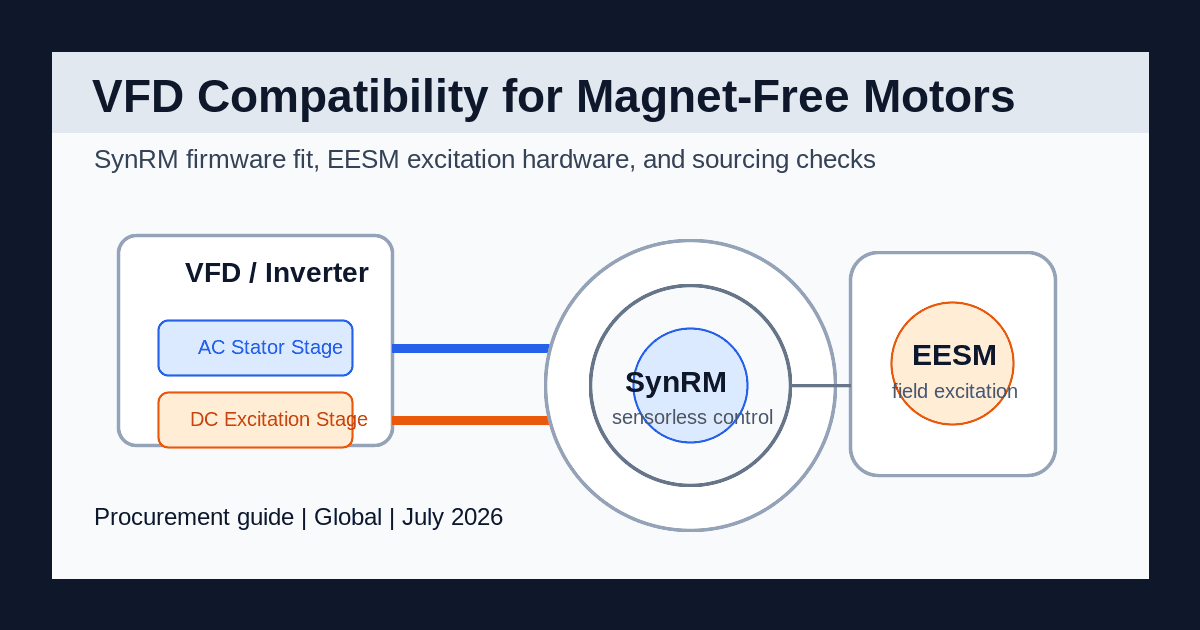
VFD Compatibility with Magnet-Free Motors: SynRM and EESM Sourcing Guide
Compare VFD compatibility for magnet-free motors in 2026: SynRM firmware, EESM excitation hardware, retrofit limits, sourcing checks, and request RFQ review.
Why Magnet-Free Motors Are the Future of Industrial Automation
Discover how magnet-free motors like SynRM and WRSM are transforming industrial automation by eliminating rare-earth risks and boosting IE5 efficiency.