
VFD Compatibility with Magnet-Free Motors: SynRM and EESM Sourcing Guide
Compare VFD compatibility for magnet-free motors in 2026: SynRM firmware, EESM excitation hardware, retrofit limits, sourcing checks, and request RFQ review.
Magnet-Free Motor VFD Compatibility for SynRM and EESM Sourcing
As global industrial facilities and automotive OEMs shift away from rare-earth permanent magnet motors to mitigate supply chain volatility, magnet-free topologies—specifically Synchronous Reluctance Motors (SynRM) and Externally Excited Synchronous Motors (EESM)—are becoming standard procurement line items. However, a critical blind spot often derails these electrification projects: drive compatibility.
Upgrading a facility or a vehicle platform to a magnet-free motor is never a simple mechanical drop-in replacement. Because SynRM and EESM operate on fundamentally different electromagnetic principles than legacy induction motors or Interior Permanent Magnet (IPM) motors, they impose strict requirements on the accompanying Variable Frequency Drive (VFD) or traction inverter.
This guide is designed for buyers, procurement teams, distributors, and integration engineers who are evaluating magnet-free motors in 2026. It breaks down the inverter control algorithms required for SynRM, the physical excitation hardware mandated by EESM, the economic realities of retrofitting existing VFD cabinets, and the strategic advantages of bundled motor-drive procurement.
Scope, Date, and Evidence Standard
This guide was published on July 20, 2026 for global procurement and application-engineering teams comparing magnet-free motor drive requirements before RFQ release. It applies to industrial VFD retrofits, OEM motor-drive packages, and EV or commercial traction inverter sourcing where SynRM or EESM is being evaluated as a rare-earth-free architecture.
Use it as a screening and supplier-question framework, not as final design approval. Exact torque-speed maps, thermal derating curves, insulation margins, excitation limits, grid harmonics, and safety compliance still need supplier data, dyno validation, and site-specific engineering review. If you already have a drive inventory or RFQ package, ask our engineering team to review the VFD fit before issuing the purchase order.
For adjacent architecture decisions, compare SynRM vs. EESM magnet-free motor sourcing and EESM vs. IPM procurement trade-offs. To scan related buyer content, use the procurement guide archive and engineering guide archive.
1. The Core Issue: Why Standard Inverters Fail
To understand the procurement implications of magnet-free motors, we must first address why standard AC drives fall short. For decades, the workhorse of the industrial sector has been the 3-phase AC induction motor (also known as an asynchronous motor). Standard VFDs using basic Volts-per-Hertz (V/Hz) or simple vector control algorithms are perfectly tuned for induction physics.
When a procurement team attempts to pair a standard induction-tuned VFD with a new magnet-free synchronous motor, several failure modes immediately surface:
- Inability to Start (Direct-on-Line Failure): A pure SynRM lacks the squirrel-cage rotor of an induction motor. Consequently, it cannot generate starting torque by simply being connected to a 3-phase power supply (Direct-on-Line or DOL). It absolutely requires a drive to manage its starting sequence.
- Loss of Rotor Synchronization: Both SynRM and EESM are synchronous machines. The rotor must spin at exactly the same speed as the stator's rotating magnetic field. If a standard drive cannot accurately calculate or track the exact angular position of the rotor, the motor will slip out of synchronization, resulting in immediate stalling, severe vibration, and overcurrent tripping.
- Missing Excitation Circuitry: In the case of EESM, the rotor requires a dedicated DC power supply to generate its magnetic field. Standard 3-phase inverters simply do not have the physical hardware outputs to provide this secondary excitation current.
Therefore, procuring a magnet-free motor dictates a simultaneous audit of your inverter infrastructure. Treating the motor and the drive as isolated line items is a high-risk procurement strategy that leads to commissioning delays and hidden integration costs.
2. SynRM VFD Requirements: The Algorithmic Challenge
Synchronous Reluctance Motors (SynRM) rely entirely on the principle of magnetic reluctance. The rotor consists of specially shaped steel laminations with intricate air gaps (flux barriers). The stator's magnetic field pulls the rotor along the path of least magnetic resistance.
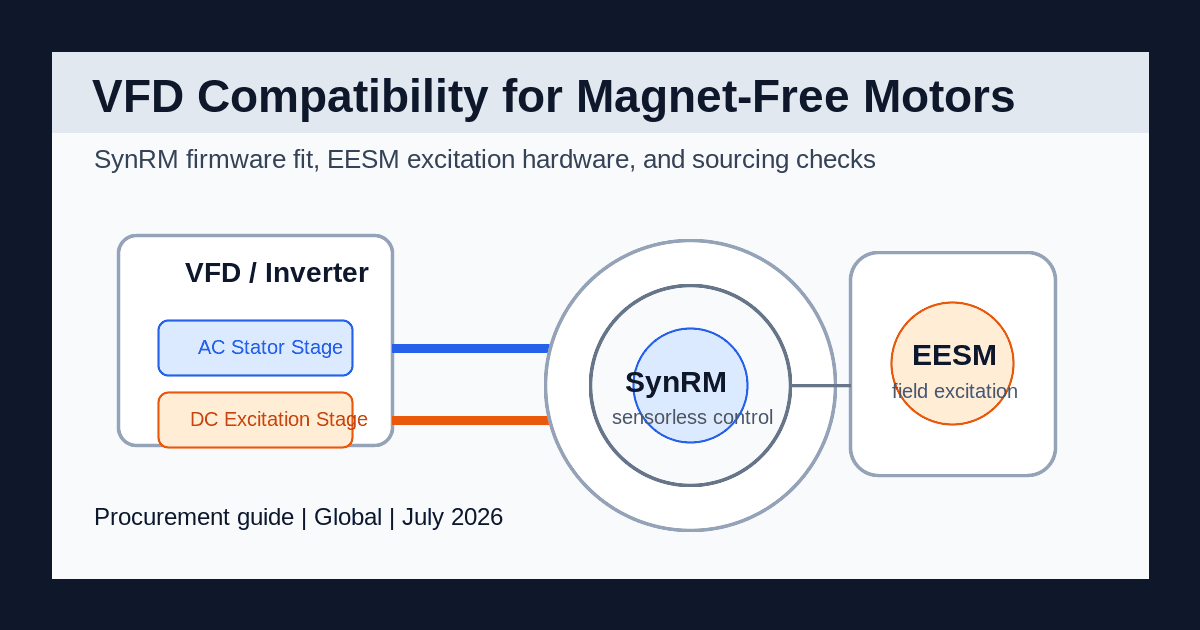
Because there are no magnets or windings on the rotor, the VFD carries the entire burden of controlling the motor's performance. The drive compatibility challenge for SynRM is primarily algorithmic and software-based.
Sensorless Vector Control and Firmware
To operate efficiently, the VFD must know the precise position of the rotor's flux barriers at all times. While adding a physical shaft encoder is one solution, it adds cost, wiring complexity, and a point of failure in harsh environments.
Modern procurement demands sensorless vector control. The VFD must possess specialized firmware capable of injecting high-frequency signal pulses into the stator. By measuring the electrical response, the drive’s microprocessor mathematically deduces the rotor's exact position, even at a standstill.
Procurement Implication: You cannot typically use a legacy 10-year-old VFD with a new SynRM. However, if you are purchasing new drives from tier-1 automation suppliers, many modern VFDs can support SynRM simply by selecting the correct motor type in the drive's parameter menu or applying a firmware update. When auditing suppliers, explicit written confirmation of "Sensorless SynRM Control Algorithms" must be part of the RFQ.
Managing Torque Ripple
Because SynRM generates torque based on the geometric alignment of steel and air gaps, it inherently produces higher torque ripple (pulsations in rotational force) than an induction motor. A standard VFD will translate this into audible noise and mechanical vibration. A SynRM-compatible VFD mitigates this by actively shaping the current waveform to counteract the geometric ripple, ensuring smooth operation critical for precision machining or HVAC applications.
3. EESM VFD Requirements: The Hardware Challenge
Externally Excited Synchronous Motors (EESM) present a significantly higher integration hurdle. Instead of magnets, the EESM rotor features coils of copper wire that act as an electromagnet.
For EESM, drive compatibility is not just a software issue; it is a hardware requirement. The drive must manage the standard 3-phase AC power to the stator and simultaneously manage the DC power to the rotor.
The Need for Dual-Output Inverters
A standard inverter features three output terminals (U, V, W) feeding the stator. An EESM drive requires those same three outputs, plus an additional, independently controlled power stage for the excitation current. This excitation stage must dynamically adjust the current based on the motor's speed and load.
For example, during low-speed, high-torque acceleration, the drive must push maximum current into the rotor to create a strong magnetic field. During high-speed cruising, the drive must precisely reduce the excitation current to actively weaken the field, thereby improving high-speed efficiency and preventing dangerous Back-EMF voltages.
The Wireless Excitation Factor
Modern EESM designs frequently use brushless inductive excitation (transferring power to the rotor wirelessly via a rotary transformer) rather than wear-prone carbon slip rings. The drive must generate a specific high-frequency AC signal to drive the primary coil of this rotary transformer.
Procurement Implication: You cannot buy a standard off-the-shelf VFD from a generic catalog and expect it to run an EESM. EESM procurement currently dictates highly coordinated sourcing. The motor and the traction inverter must be co-developed or specifically validated together to ensure the excitation logic matches the motor's thermal and magnetic limits.
4. Drive Compatibility Decision Matrix
To streamline vendor evaluation, use this matrix to compare drive upgrade paths when transitioning from legacy induction motors to magnet-free alternatives.
| Parameter | Legacy Induction (Asynchronous) | SynRM (Magnet-Free) | EESM (Magnet-Free) |
|---|---|---|---|
| VFD Necessity | Optional (Can run DOL) | Strictly Required | Strictly Required |
| Drive Hardware Needed | Standard 3-Phase Inverter | Standard 3-Phase Inverter | Dual-Output Inverter (AC + DC) |
| Drive Software Needed | Basic V/Hz or Vector Control | Dedicated Sensorless SynRM Algorithm | Complex Stator/Rotor Sync Logic |
| Retrofit Viability | Baseline | High (If existing VFD supports firmware flashes) | Very Low (Usually requires new hardware) |
| Torque Ripple Mgmt | Minimal requirement | Critical (Handled by drive firmware) | Moderate |
| Efficiency Ceiling | IE3 / IE4 | IE5 (Ultra-Premium) | IE5 equivalent at high speeds |
5. The Economic Equation: Unbundled vs. Packaged Procurement
When sourcing magnet-free systems, buyers face a strategic choice between unbundled sourcing (buying the motor from Supplier A and the drive from Supplier B) and packaged procurement (buying a validated motor-drive pair from a single supplier).
The Risks of Unbundled Sourcing
Purchasing a SynRM from an independent motor house and attempting to pair it with your facility's legacy VFD brand introduces significant integration risk. Even if the VFD claims "SynRM compatibility," the auto-tuning sequence (where the drive maps the motor's electrical characteristics) often fails due to slight variations in magnetic inductance profiles between manufacturers. This leads to hours of engineering time spent manually adjusting PI controller gains, effectively erasing any upfront CapEx savings.
The Value of Packaged Procurement
For 2026, the overwhelming consensus among industrial automation experts is to procure SynRM and EESM as verified packages.
- Guaranteed IE5 Compliance: System efficiency ratings (such as the IES classes defined by IEC 61800-9-2) can only be certified when the motor and drive are tested together.
- Single Point of Accountability: If the motor stalls or fails to meet the torque curve, a packaged procurement contract prevents finger-pointing between the drive vendor and the motor manufacturer.
- Plug-and-Play Commissioning: Pre-mapped parameter sets allow technicians to commission the system in minutes rather than days.
While unbundled sourcing might yield a 5-10% lower initial BOM cost, packaged procurement reliably delivers lower Total Cost of Ownership (TCO) through accelerated commissioning and guaranteed energy yield.
If supplier answers conflict on SynRM firmware support, EESM excitation hardware, or IES system-efficiency evidence, pause the split-source bid and request a compatibility review before separating the motor and drive purchase orders.
6. Sourcing & Engineering Checklist
Before authorizing a purchase order for magnet-free motors, procurement teams and application engineers must execute the following validation steps:
- Audit the Existing VFD Fleet: Inventory your current drives. Note the manufacturer, model, age, and firmware version. Contact the VFD OEM to explicitly ask if that specific firmware supports "Sensorless Synchronous Reluctance Motor Control."
- Define the Starting Torque Requirement: SynRM can struggle with ultra-high starting torque (e.g., loaded crushers or heavy conveyors) without a shaft encoder. Verify with the drive supplier that their sensorless algorithm can deliver the required breakaway torque.
- Verify EESM Excitation Compatibility: If sourcing an EESM, demand the supplier's drive compatibility list. If they do not offer their own matched inverter, they must provide a list of Tier-1 drives that possess the necessary excitation hardware and have been physically dyno-tested with their motor.
- Demand System-Level Efficiency Data: Do not accept isolated motor efficiency numbers. Request an IES (International Efficiency of Systems) certificate proving the combined motor-and-drive efficiency across your specific operating load profile.
- Evaluate Network Protocols: Ensure the new drive required for the magnet-free motor natively supports your facility's industrial communication protocols (Profinet, EtherNet/IP, Modbus TCP) to avoid costly gateway bridges.
- Assess Thermal Limits at Low Speeds: Magnet-free motors driven by VFDs at very low speeds lose the cooling effect of their shaft-mounted fans. Ensure the VFD parameter setup includes correct thermal derating curves to prevent burnout.
7. Application Boundaries: When to Keep Your Induction Motors
Magnet-free motors offer superior efficiency and isolate your supply chain from rare-earth price shocks. However, there are boundary conditions where forcing a transition is economically irrational due to VFD requirements:
- Direct-on-Line (DOL) Applications: If you have applications (like remote agricultural pumps or basic ventilation fans) that operate at a single fixed speed via a simple contactor, a magnet-free motor is not viable. Adding a VFD solely to enable a SynRM will drastically increase the payback period. Stick with premium efficiency (IE3/IE4) induction motors.
- Capital-Constrained Retrofits: If a facility has recently invested millions in standard VFD cabinets that lack SynRM firmware support, replacing those drives prematurely to accommodate new magnet-free motors will destroy the project's ROI. Wait for the natural VFD replacement cycle.
- Ultra-Harsh Electrical Environments: If the motor is located hundreds of meters away from the VFD (common in mining or deep-well pumping), the long cable runs heavily distort the high-frequency signals required for sensorless SynRM control. Standard induction motors are significantly more tolerant of long cable lengths.
8. Frequently Asked Questions (FAQ)
Q: Can I upgrade my existing standard VFD to run a SynRM by simply updating the firmware? A: In many modern drives (manufactured in the last 5-7 years by Tier-1 suppliers), yes. The hardware (IGBTs and current sensors) is often sufficient, and a firmware flash unlocks the SynRM algorithms. However, older drives lack the processing power necessary for the complex mathematical models and must be replaced.
Q: Why does EESM require a completely different hardware drive, while SynRM doesn't? A: SynRM generates its rotor field passively through the geometry of its steel core reacting to the stator. EESM requires active DC electrical current to be physically pumped into the spinning rotor. A standard drive simply does not have the extra wiring terminals or internal power electronics to generate and regulate this secondary DC circuit.
Q: Will installing a VFD for a magnet-free motor introduce harmonic distortion into my facility's power grid? A: Yes, all standard 6-pulse VFDs introduce harmonics, regardless of whether they are driving an induction motor or a magnet-free motor. Procurement teams must specify drives with built-in DC chokes, AC line reactors, or opt for Active Front End (AFE) drives to comply with IEEE 519 harmonic standards.
Q: Is it true that SynRM motors run quieter than induction motors on VFDs? A: This depends entirely on the VFD. If driven by a poorly matched VFD, a SynRM will exhibit high torque ripple and run louder than an induction motor. If driven by a fully optimized, matched VFD, the SynRM can run exceptionally smoothly, and its lower operating temperature often means cooling fans can run slower, reducing overall acoustic noise.
9. Sources & Verifiable References
- IEC 61800-9-2 Standard: The international standard defining the energy efficiency of power drive systems, motor starters, power electronics, and their driven applications (System efficiency classification IES). IEC Webstore Reference
- Motor Control Theory & Sensorless Algorithms: Academic validation of the mathematical models required for sensorless control of Synchronous Reluctance Motors. IEEE Xplore - SynRM Control
- IEEE 519 Harmonic Control: Reference standard for harmonic control in electric power systems, relevant when specifying VFD front ends, line reactors, filters, or active front ends. IEEE 519 Standard Page
Is your facility ready to adopt magnet-free IE5 efficiency without the integration headaches? Sourcing magnet-free motors requires precision matching with drive infrastructure. Our engineering team provides verified, dyno-tested motor-and-drive packages that guarantee IE5 performance out of the box, eliminating commissioning risks.
Contact our Engineering Support Team Today to audit your current VFD fleet and design a seamless retrofit strategy for SynRM and EESM integration.
Author

More Posts
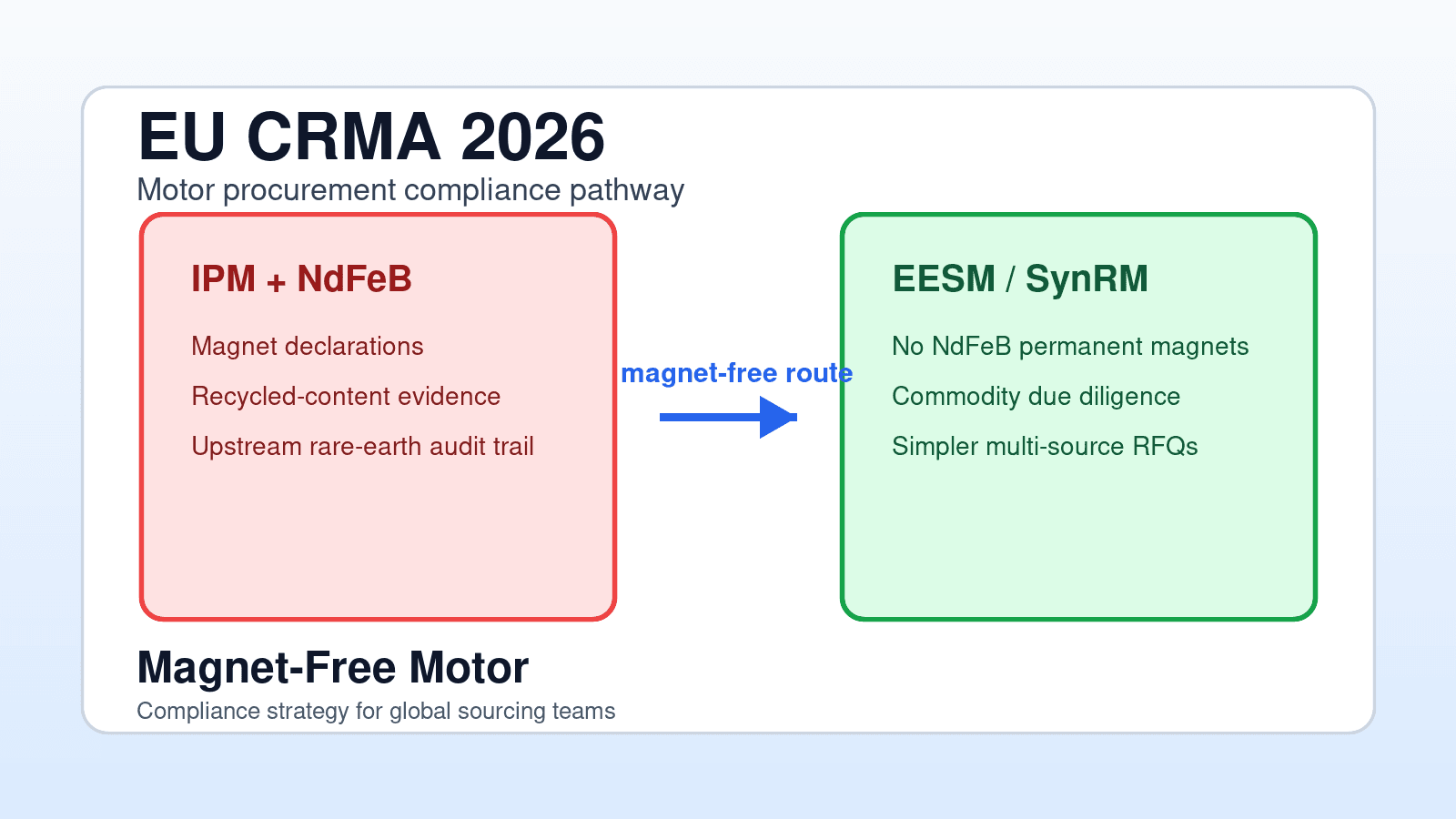
EU CRMA 2026: Why Magnet-Free Motors Are the Safest Compliance Strategy
How the EU Critical Raw Materials Act (CRMA) affects 2026 motor procurement. Compare NdFeB tracking overhead against magnet-free EESM and SynRM alternatives.
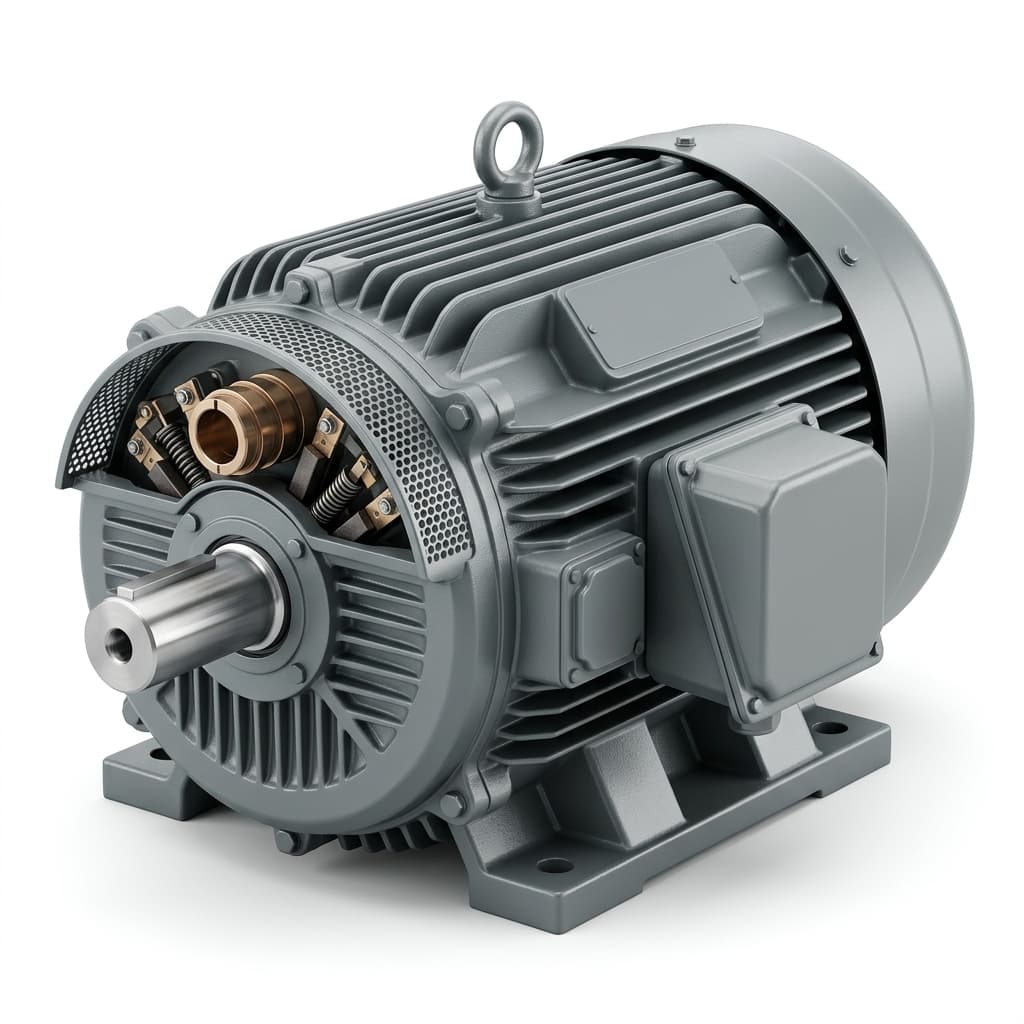
Why Magnet-Free Motors Are the Future of Industrial Automation
Discover how magnet-free motors like SynRM and WRSM are transforming industrial automation by eliminating rare-earth risks and boosting IE5 efficiency.
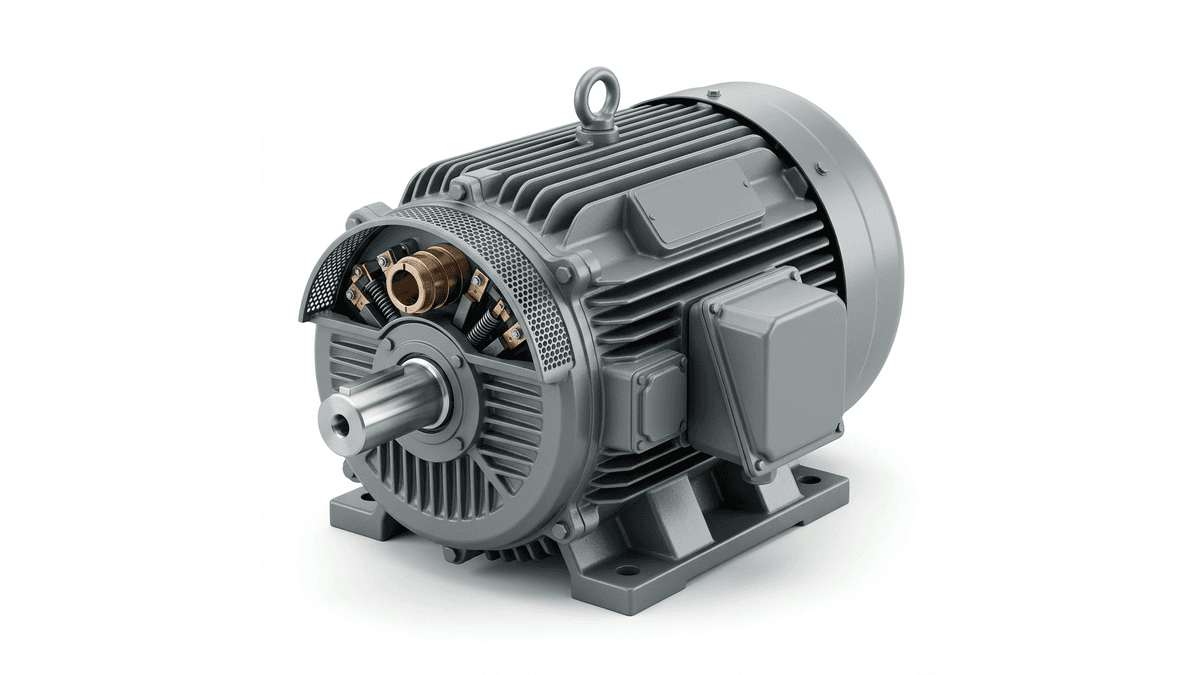
EESM vs. IPM Motors in 2026: Cost, Supply Chain, and Procurement Guide
Compare EESM vs. IPM motors for magnet-free motor sourcing in 2026: rare-earth risk, copper cost, inverter needs, efficiency, and RFQ checks.