
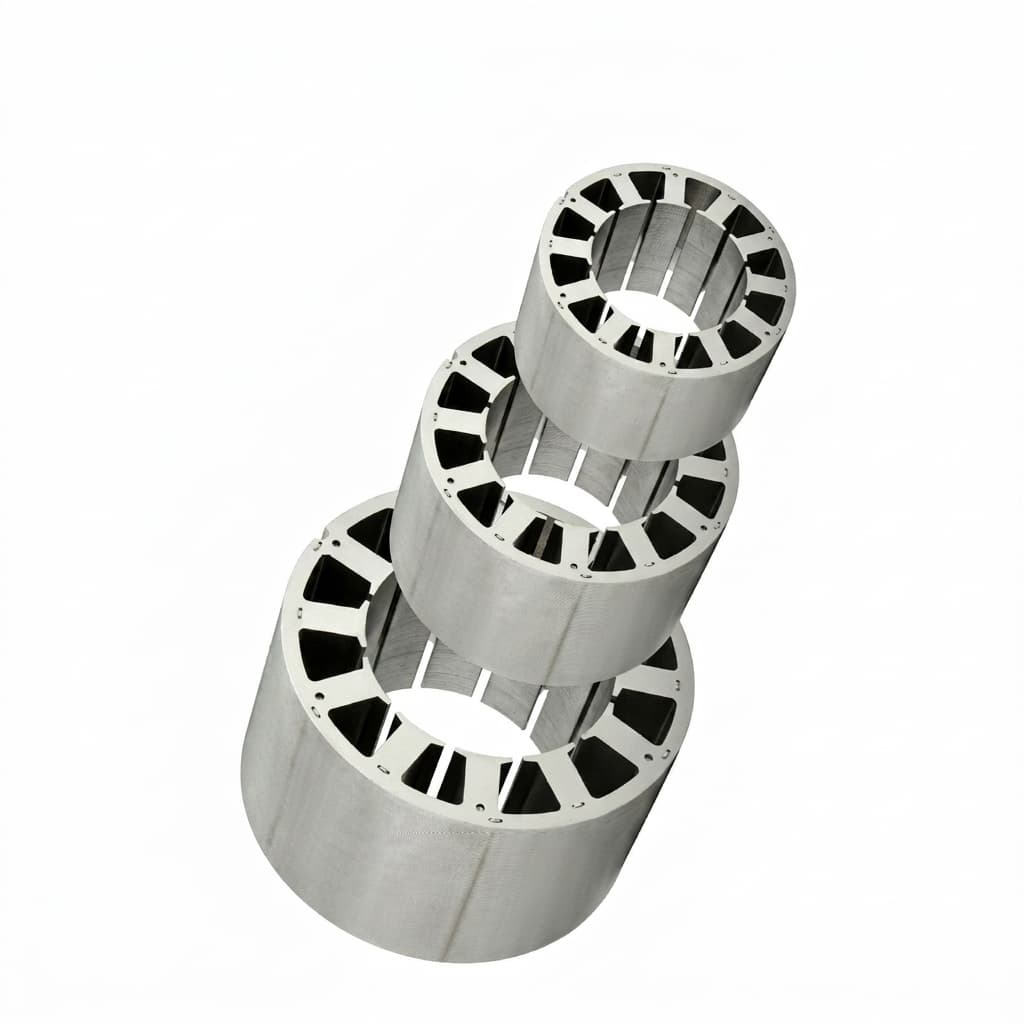
How to Audit a B2B Motor Manufacturer: Evaluating OEM Capabilities
A buyer's guide to auditing motor manufacturers. Learn how to evaluate testing labs, dyno capacity, and quality control in magnet-free motor production.
How to Audit a B2B Motor Manufacturer: Evaluating OEM Capabilities
The short answer: A thorough factory audit should cover 5 core areas — QMS traceability, winding automation, testing labs, engineering depth, and supply execution — using a weighted scoring matrix. Suppliers scoring below 80% on the combined matrix represent unacceptable risk for global OEM integration. Request specific evidence (SPC data, weld inspection records, dyno test reports) rather than relying on certifications alone.
Selecting a manufacturing partner for industrial or automotive motors is a high-stakes decision. The failure of a single traction motor or industrial drive can result in catastrophic downtime, costly warranty claims, and severe reputational damage.
For procurement teams and lead engineers transitioning to magnet-free motor architectures (like SynRM, SRM, or WRSM), auditing a supplier's capability requires evaluating actual process capability. Here is a practical checklist on how to audit an OEM motor manufacturer.
Pre-Audit Checklist: What to Request Before the Visit
Before booking flights, request these documents to pre-screen the supplier:
| Document | What It Reveals | Red Flag If Missing |
|---|---|---|
| ISO 9001 certificate (current) | Basic QMS existence | Immediate disqualification |
| IATF 16949 (if automotive) | Automotive-grade process control | Cannot supply tier-1 automotive |
| Organization chart (quality dept) | Quality independence from production | Quality reports to production manager |
| Equipment list (key machines) | Actual manufacturing capability | Vague or outdated list |
| Sample inspection report (redacted) | Real process capability data | "We can prepare one" response |
| Material supplier qualification list | Supply chain depth | Single-source for critical materials |
| Recent corrective action report (8D) | Problem-solving maturity | "We've never had a quality issue" |
1. Traceability and Quality Management Systems (QMS)
A baseline ISO 9001 certification is mandatory, but insufficient for high-stakes OEM manufacturing. During an audit, you must verify the depth of their QMS integration.
- Component Traceability: Can the manufacturer track a finished motor back to the specific batch of electrical steel or the exact spool of copper wire used? In the event of a field failure, full lot traceability is essential for containing the defect.
- Statistical Process Control (SPC): Walk the factory floor and look for real-time SPC dashboards. Are critical-to-quality (CTQ) dimensions—such as rotor-stator air gap concentricity or hairpin weld depth—being monitored dynamically, or just checked at the end of the line?
Traceability Depth Levels
| Level | What's Traced | Buyer Value | Industry Standard |
|---|---|---|---|
| Level 1 (Basic) | Final motor serial → production date | Minimal — batch recall only | ISO 9001 minimum |
| Level 2 (Standard) | Serial → component lot numbers | Can isolate defect to material batch | Most industrial suppliers |
| Level 3 (Advanced) | Serial → material lots → individual process records | Full root cause analysis possible | Automotive tier-1 |
| Level 4 (Full digital) | Real-time MES linking every operation, operator, machine parameter | Predictive quality, zero-defect target | Best-in-class EV motor plants |
2. Advanced Winding and Assembly Automation
The quality of a modern high-efficiency motor is directly tied to its winding consistency. Manual or semi-automated winding processes introduce unacceptable variations in phase resistance and inductance.
- Hairpin Lines: If auditing an EV traction motor supplier, inspect their hairpin forming and laser welding lines. Look for integrated automated optical inspection (AOI) systems that verify every single weld in real-time.
- Impregnation Processes: Evaluate their stator varnish or resin impregnation process. Do they use traditional dip-and-bake, or advanced trickle impregnation and vacuum pressure impregnation (VPI) for superior thermal bonding and vibration resistance?
Winding Process Capability Benchmarks
| Process | Minimum Acceptable Cpk | World-Class Cpk | Key Measurement |
|---|---|---|---|
| Stator bore concentricity | 1.33 | 2.0+ | CMM measurement |
| Phase resistance balance | 1.33 (±2%) | 1.67 (±1%) | Precision bridge |
| Hairpin bend angle | 1.33 | 2.0+ | Vision measurement |
| Weld joint resistance | 1.33 | 1.67+ | 4-wire micro-ohm |
| Slot liner position | 1.0 | 1.33+ | Camera inspection |
| Stack length tolerance | 1.33 | 2.0+ | Height gauge |
3. In-House Testing and Validation Laboratories
A tier-1 OEM partner must possess robust, in-house validation capabilities to prove that their magnet-free designs perform to specification under extreme stress.
- End-of-Line (EOL) Dyno Testing: Every single motor leaving the facility should undergo EOL testing. Verify their dyno capacity. Are they testing under load, or just doing free-spin tests? Do they conduct high-voltage surge and NVH (Noise, Vibration, Harshness) analysis on the line?
- Environmental Validation: Inspect their R&D lab for thermal shock chambers, salt spray cabinets, and vibration tables. Magnet-free motors often operate in harsh industrial environments; the supplier must demonstrate they perform accelerated life testing (ALT) simulating decades of abuse.
Essential Test Equipment Checklist
| Equipment | Purpose | Minimum Specification |
|---|---|---|
| Dynamometer | Load testing, efficiency mapping | Torque range covers product family, ±0.1% accuracy |
| Hipot tester | Dielectric strength verification | 0–5kV AC/DC, with leakage current measurement |
| Surge tester | Inter-turn insulation verification | 0–10kV, with waveform comparison |
| Micro-ohmmeter | Winding resistance | 0.1μΩ resolution, 4-wire Kelvin |
| Vibration analyzer | NVH characterization | Tri-axial accelerometer, FFT analysis |
| Thermal imaging camera | Hot-spot identification | ±2°C accuracy, 640×480 resolution |
| Balance machine | Rotor dynamic balance | ISO 1940 G2.5 or better capability |
| Salt spray chamber | Corrosion resistance | ASTM B117 or ISO 9227 |
| Thermal shock chamber | Cycling reliability | -40 to +200°C, under 15 min transition |
4. Engineering Depth and Co-Development Capability
Transitioning to magnet-free technology requires tight integration between the motor and the inverter. Your supplier should not just be a "build-to-print" shop; they need deep electromagnetic and control engineering expertise.
- Simulation Tools: Do they utilize advanced FEA (Finite Element Analysis) software like ANSYS Maxwell or Motor-CAD? Ask to review a thermal simulation or magnetic flux density report for a recent project.
- Inverter Mapping: Can the manufacturer provide highly accurate flux linkage maps (Ld, Lq curves) and efficiency contour maps necessary for your software team to calibrate the VFD or motor controller?
Engineering Capability Assessment Questions
Ask these specific questions during the audit. Vague or evasive answers are red flags:
- "Show me the Ld/Lq mapping data for your most recent SynRM project." (Tests electromagnetic design depth)
- "What is your typical Cpk for air gap concentricity on a 200mm bore stator?" (Tests process control maturity)
- "Walk me through your last 8D corrective action for a winding failure." (Tests problem-solving culture)
- "How do you validate VFD compatibility before shipping samples?" (Tests system-level thinking)
- "What is your rotor balance grade target, and show me the last 50 balance reports?" (Tests data availability and consistency)
5. Supply Chain and Delivery Execution
A frequently overlooked audit area is the supplier's logistics and supply chain management:
| Assessment Area | What to Verify | Acceptable Evidence |
|---|---|---|
| Raw material lead time | Buffer stock for electrical steel, copper | Inventory records, supplier agreements |
| Production capacity | Weekly/monthly output vs. your forecast | Production schedule, OEE data |
| Packaging qualification | Drop test, vibration test for export | Packaging qualification report, photos |
| Export documentation | Commercial invoice, packing list, CoO | Sample document set from recent shipment |
| On-time delivery rate | Historical performance | Last 12 months delivery log with dates |
OEM Manufacturer Audit Scoring Matrix
When our clients conduct on-site factory audits, we recommend using this weighted matrix to evaluate tier-1 motor suppliers objectively:
| Audit Category | Key Indicators | Weighting | Minimum Acceptable Standard |
|---|---|---|---|
| QMS & Traceability | MES integration, barcode scanning, SPC dashboards, 8D process | 20% | Level 2+ traceability, active SPC on 3+ CTQ parameters |
| Automation & Winding | Hairpin forming, robotic insertion, laser welding, AOI | 30% | Fully automated stator lines; no manual winding for high-volume orders |
| Validation & Testing | EOL dyno capacity, thermal chambers, NVH testing, hipot/surge | 20% | 100% End-of-Line testing under load; in-house environmental lab |
| Engineering Depth | FEA modeling, inverter mapping, DFM capability, 8D history | 15% | Dedicated electromagnetic design team capable of custom flux mapping |
| Supply & Delivery | Material buffer, capacity planning, packaging, on-time rate | 15% | ≥95% OTD, qualified export packaging, under 4 week standard lead time |
Manufacturers scoring below 80% on this matrix pose a severe supply chain risk for global OEM integration.
Scoring Guide
| Score Range | Rating | Recommendation |
|---|---|---|
| 90–100% | A — Strategic Partner | Long-term framework agreement candidate |
| 80–89% | B — Qualified Supplier | Approved with improvement plan |
| 70–79% | C — Conditional | Significant gaps, re-audit in 6 months |
| Below 70% | D — Not Qualified | Do not proceed with sourcing |
Summary
A successful audit separates generic assemblers from true strategic manufacturing partners. At Magnet-Free Motor, we invite B2B clients to audit drawing control, process checkpoints, sample evidence, and outgoing records before releasing pilot or production orders. Transparency is the basis of industrial trust.
The key takeaway: request specific data, not general claims. A supplier that can show you their last 50 balance reports, their SPC trends for air gap concentricity, and their 8D history is a fundamentally different partner than one who shows you a PowerPoint deck about "world-class quality."
Related Reading
- Hairpin Winding in EV Traction Motors — Key process details to inspect during a hairpin line audit.
- EESM vs. IPM Motors: Procurement Comparison — Understanding what to validate when evaluating EESM suppliers.
- SRM Motors for Harsh Environments — Unique audit considerations for switched reluctance motor production.
Author

Categories
More Posts
EESM vs. IPM Motors in 2026: Cost, Supply Chain, and Procurement Guide
Compare EESM vs. IPM motors for magnet-free motor sourcing in 2026: rare-earth risk, copper cost, inverter needs, efficiency, and RFQ checks.
The Role of Hairpin Winding in High-Performance EV Traction Motors
Learn why automated hairpin winding technology is essential for maximizing power density and thermal efficiency in next-generation EV traction motors.
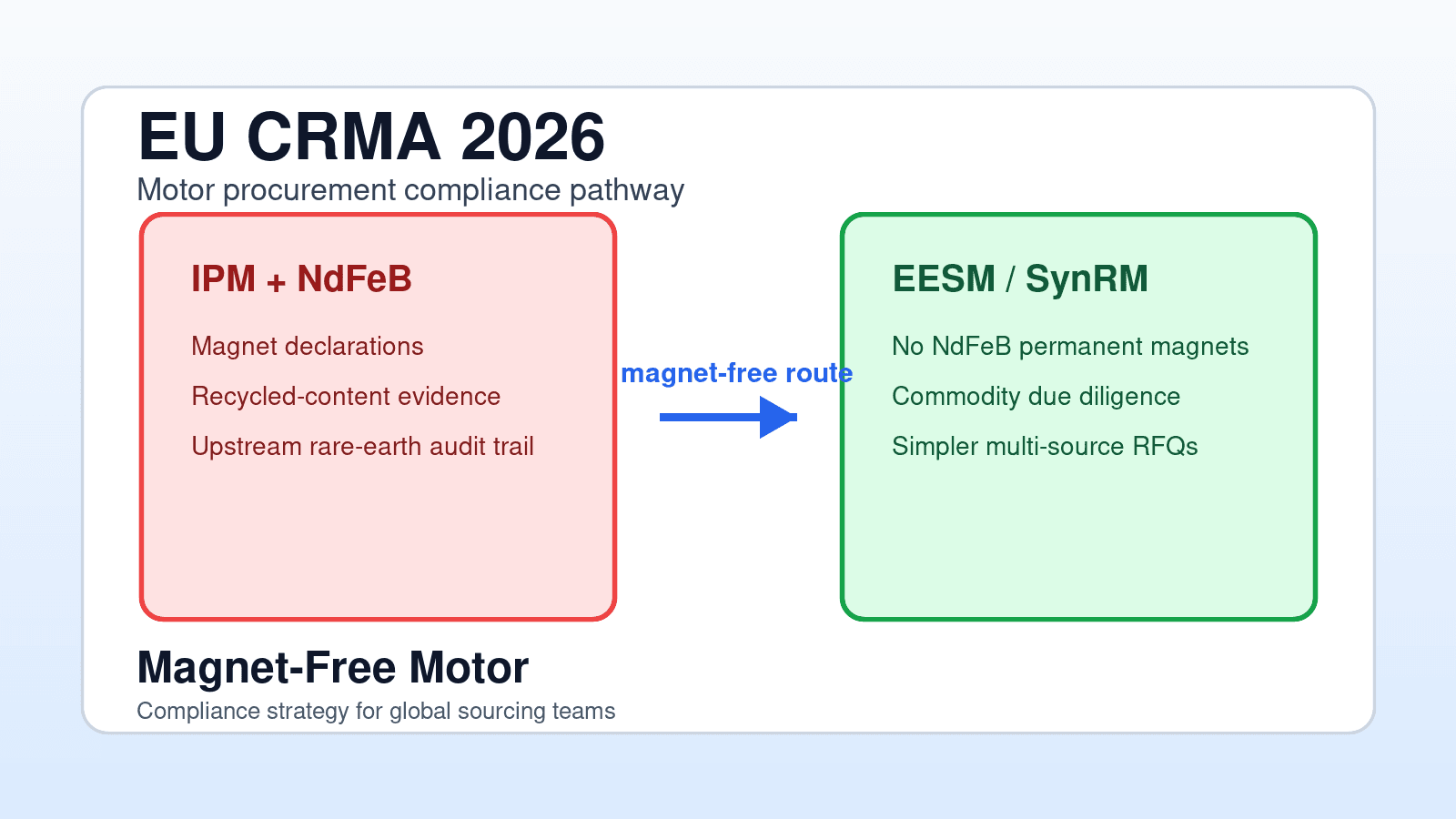
EU CRMA 2026: Why Magnet-Free Motors Are the Safest Compliance Strategy
How the EU Critical Raw Materials Act (CRMA) affects 2026 motor procurement. Compare NdFeB tracking overhead against magnet-free EESM and SynRM alternatives.